Beyblade X Rules
This rulebook is developed by the World Beyblade Organization, a fan-run volunteer project that has supported competitive Beyblade since 2008. The World Beyblade Organization is not affiliated with Takara Tomy, Hasbro or any other official Beyblade license holders.
This rulebook is based on the official Beyblade X rules published by Takara Tomy (B4) and extensive research of how those rules are applied at official events. Gameplay results are generally identical to the official rules. Some alternate rulesets that differ more from the official rules are also included.
About Beyblade
- Beyblade is a game where two bladers (players) compete by launching spinning tops known as Beys into battle within a stadium.
- Bladers can change how their Beys perform in battle by customizing their parts and launching them with various techniques.
- The last Bey to remain spinning in the battle zone — the central area of the stadium — wins the battle.
- Beys are finished when they stop spinning, burst (parts detach), or become unable to return to the battle zone.
- The winner of each battle receives points based on how and where the opponent’s Bey was finished.
- The objective of the game is to, through multiple battles, earn enough points (default: 4) to win the match.
Game Equipment
IMPORTANT: All equipment used must comply with equipment regulations.
Bey
- A Bey (often referred to as “a Beyblade”) is the spinning top used to battle.
- A complete Bey consisting of a blade, ratchet, and bit must be used.
- CX blades must contain all three parts: a lock chip, main blade, and assist blade.
- CX Expand blades must contain all four parts: a lock chip, over blade, metal blade, and assist blade.
- Ratchet-integrated parts such as the BulletGriffon blade and Operate bit cannot use a ratchet.
- A complete BulletGriffon blade consists of the upper part (Bullet/Rocket) and the main body lower part Griffon.
Deck
- A deck is a set of 3 Beys that is required for most battle types.
- A deck cannot include more than one copy of any part, except for basic lock chips.
- Basic lock chips with the same design and/or name can be included any number of times.
- Metal lock chips (Valkyrie and Emperor) can be included once each.
- Parts cannot be exchanged between Beys within a deck at any point during a match.
Determining whether parts are the same
- Parts are generally considered the same part when they have the same name. The original Japanese product names take priority.
- Recolors: Parts that have been re-released in different colors are still considered the same as the original part.
- Retools: Parts that have similar designs because they are based on another part — such as Optimus Primal being based on SharkEdge — are considered retools. While retools look similar to the parts they are based on, they are considered different, unique parts.
- Mold Differences: Copies of the same part which feature minor differences — such as PhoenixWing, which has received at least two revisions — are considered different molds. Different molds of a part are all considered to be the same part.
- Version 2.0 blades: Version 2.0 blades are considered the same part as the original blades they are based on.
- Versions: Parts that have been re-released in new versions, such as TyrannoBeat Jurassic World Version (branded as T. Rex) being a new version of TyrannoBeat, are still considered the same part as the original.
- Lightning L-Drago blade: Lightning L-Drago (Rapid-Hit Type) and Lightning L-Drago (Upper Type) cannot be used together in a deck. However, they are not considered the same part in other situations, such as replacing a part when it breaks.
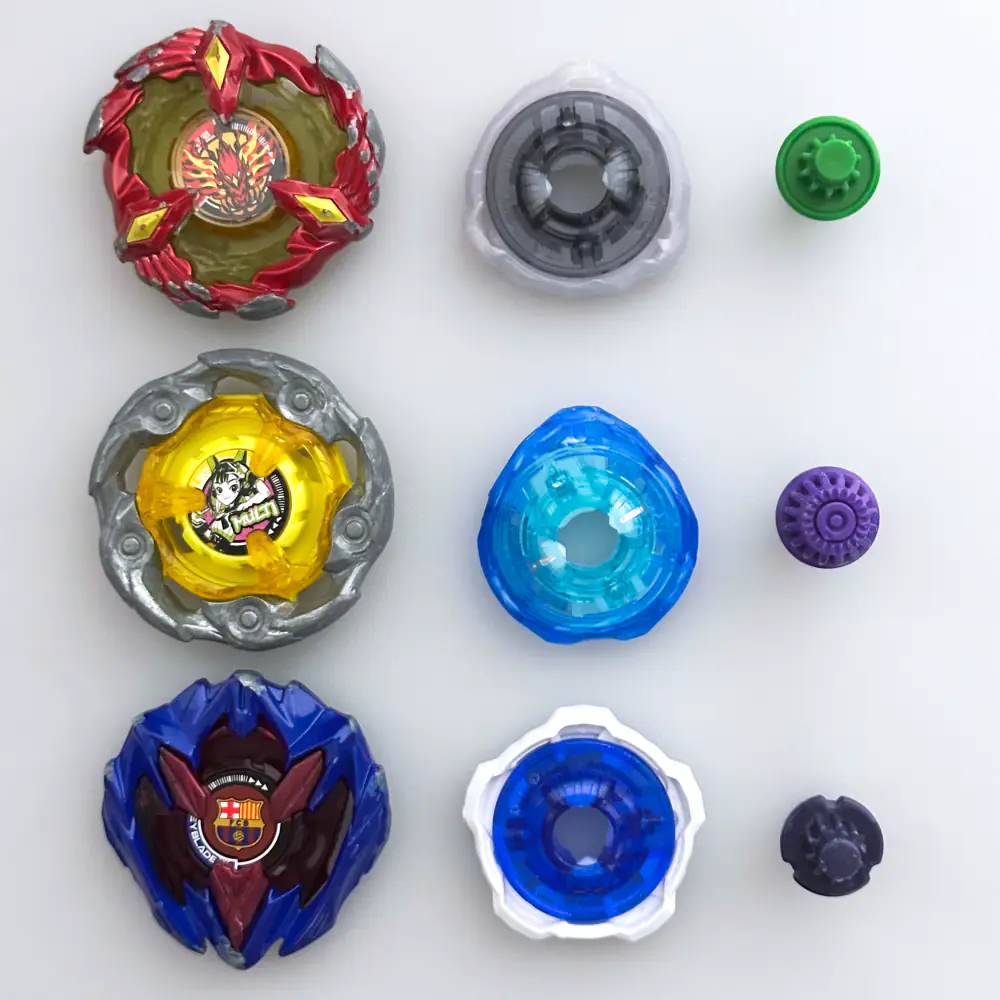
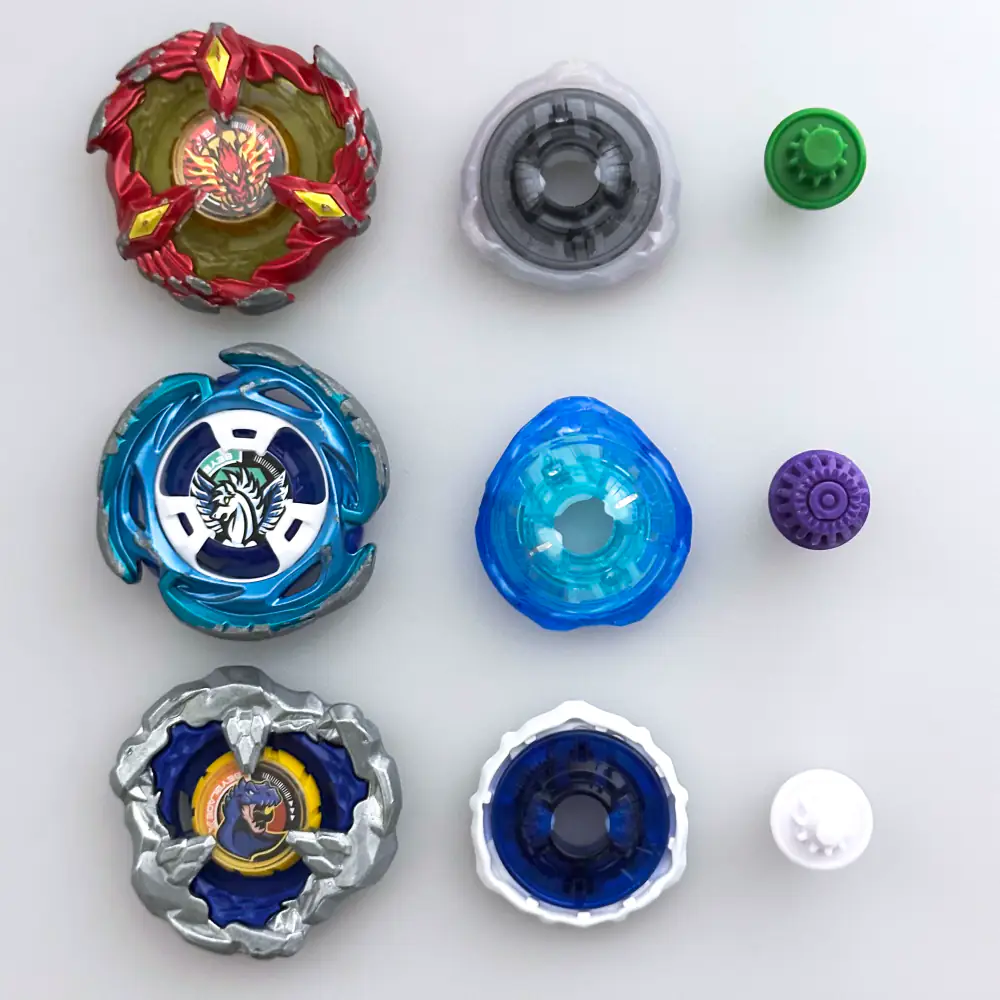
- PhoenixWing 3-60R
- WizardRod 1-60L
- DranBuster 5-60LR
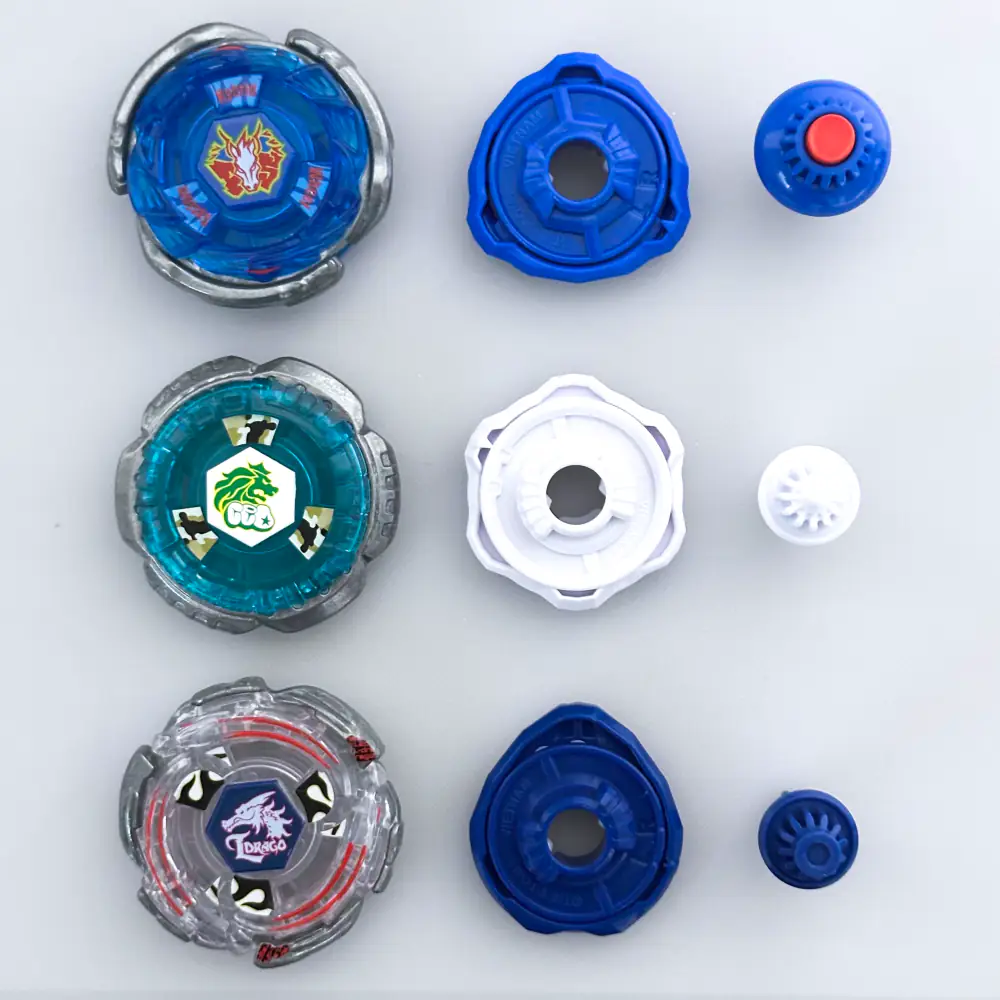
- StormPegasis 3-70RA
- Rock Leone 6-80 GN
- Lightning L-Drago (Upper) 1-60F
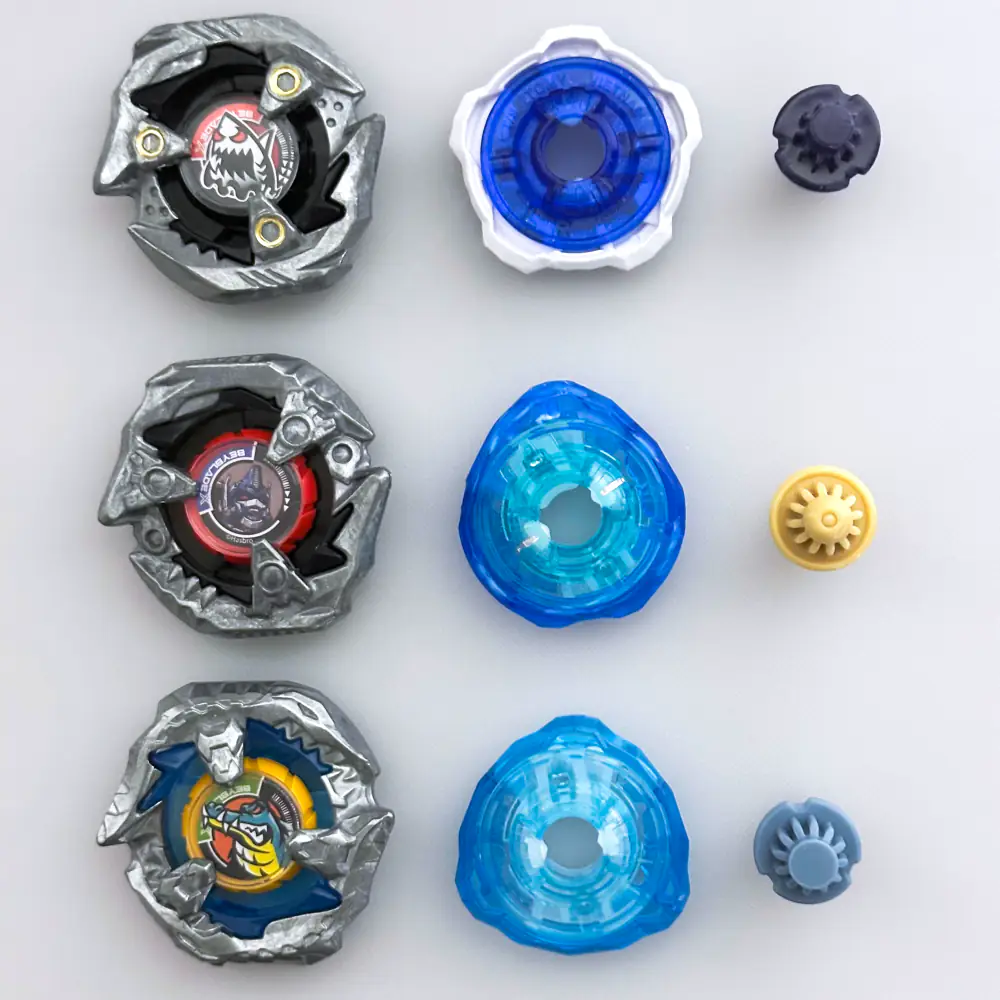
- SharkEdge 5-60LR
- OptimusPrimal 1-60U
- CrocCrunch 3-60LF
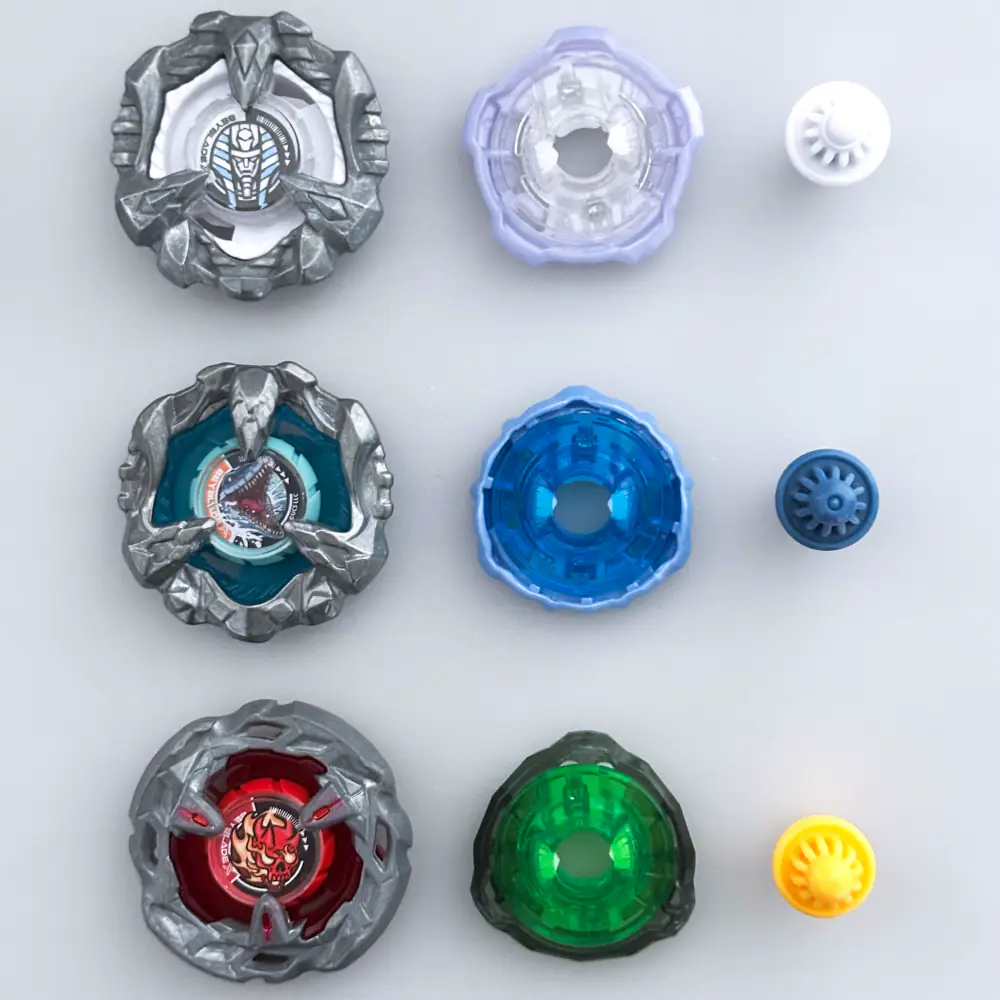
- SphinxCowl 5-60O
- TriceraSpiky 9-60U
- HellsScythe 3-60B
- PhoenixWing 3-60R
- AeroPegasus 1-60L
- TyrannoRoar 9-60W
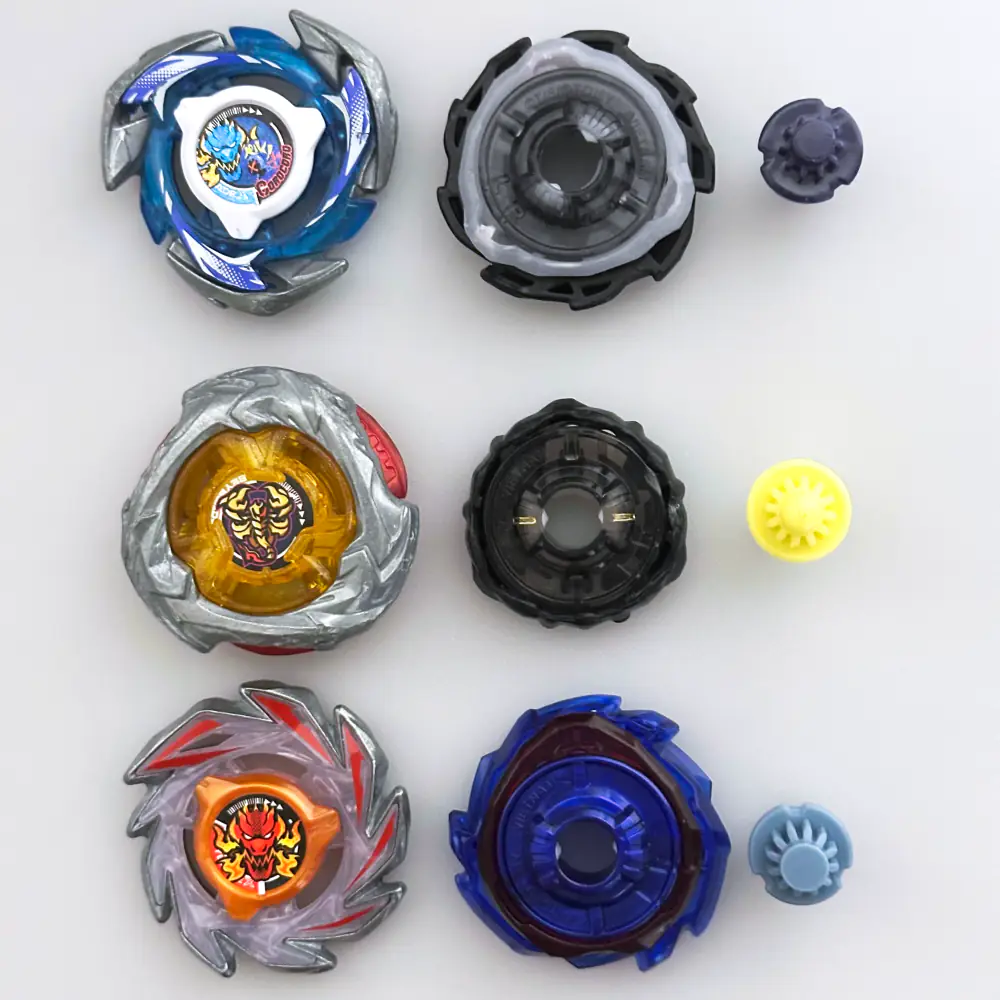
- DranBrave J3-60LR
- ScorpioSpear 9-60FB
- DranBrush S1-60LF
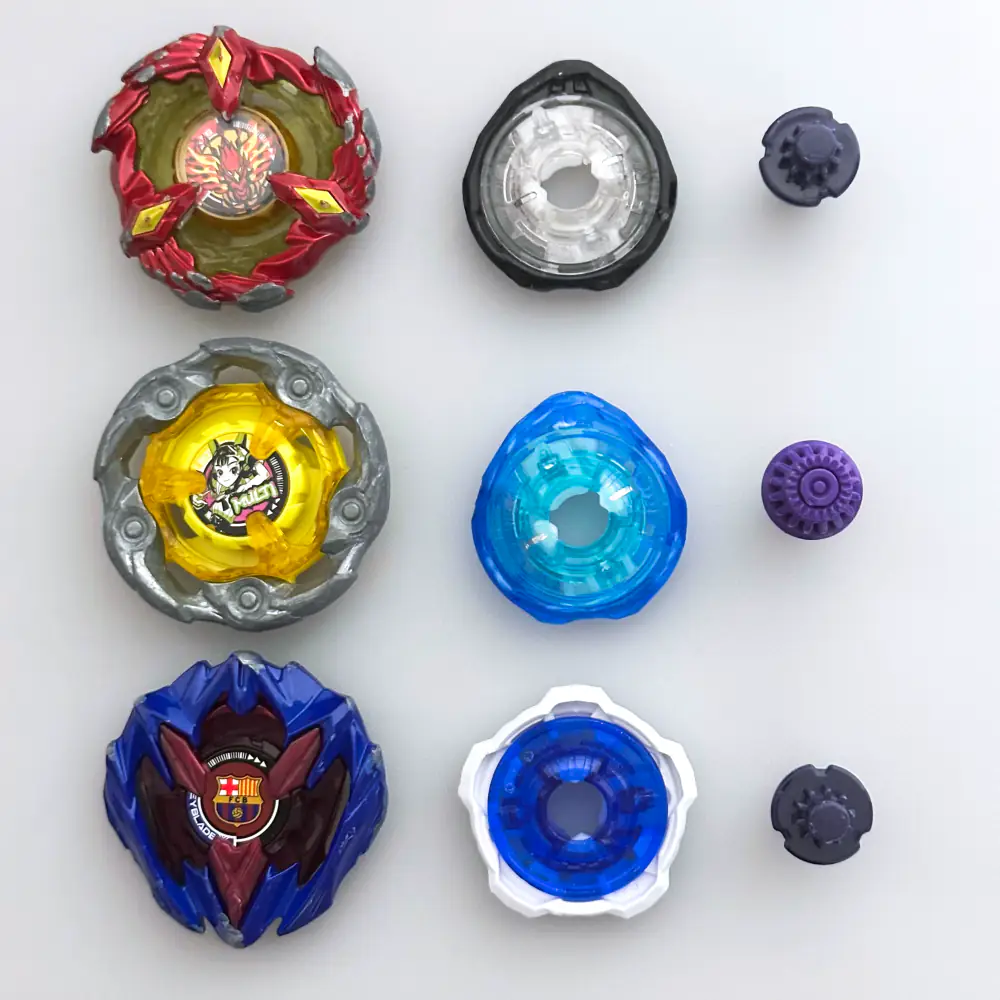
- PhoenixWing 1-60LR
- WizardRod 1-60L
- DranBuster 5-60LR
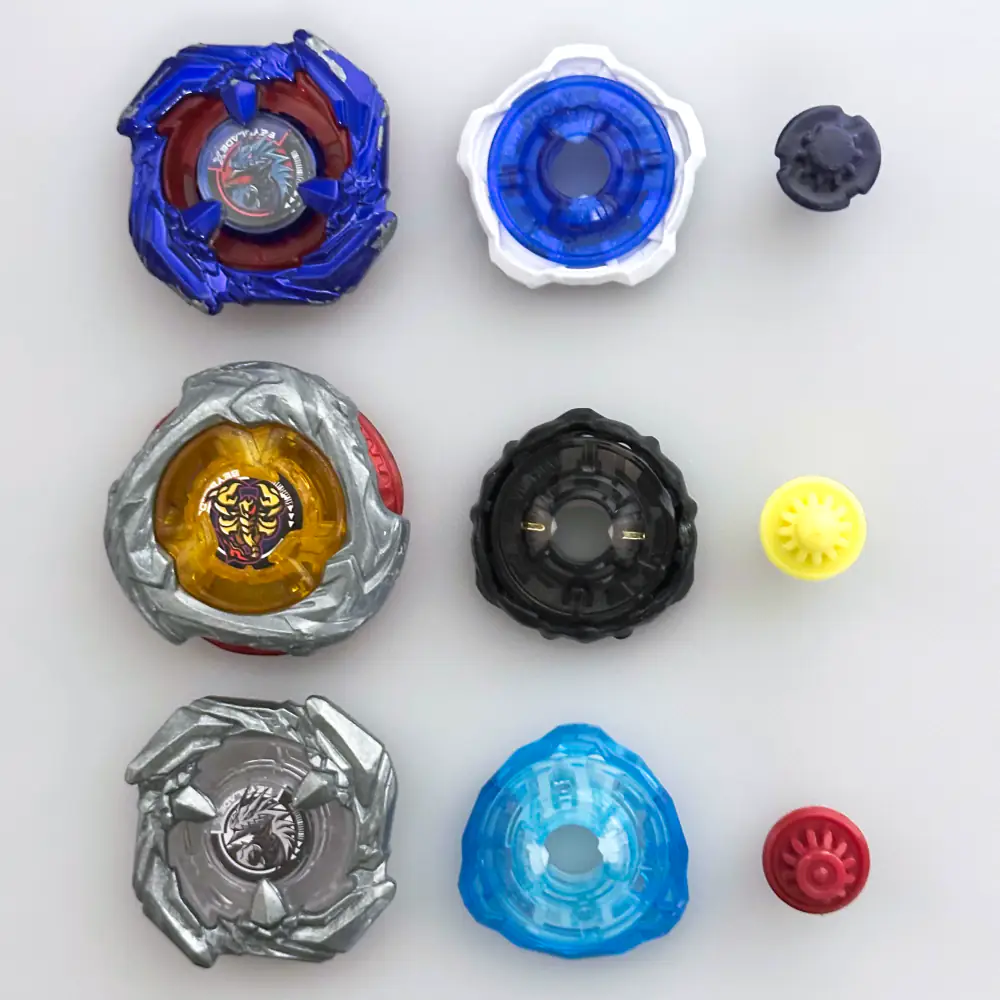
- CobaltDrake 5-60LR
- ScorpioSpear 9-60FB
- CobaltDrake 3-60P
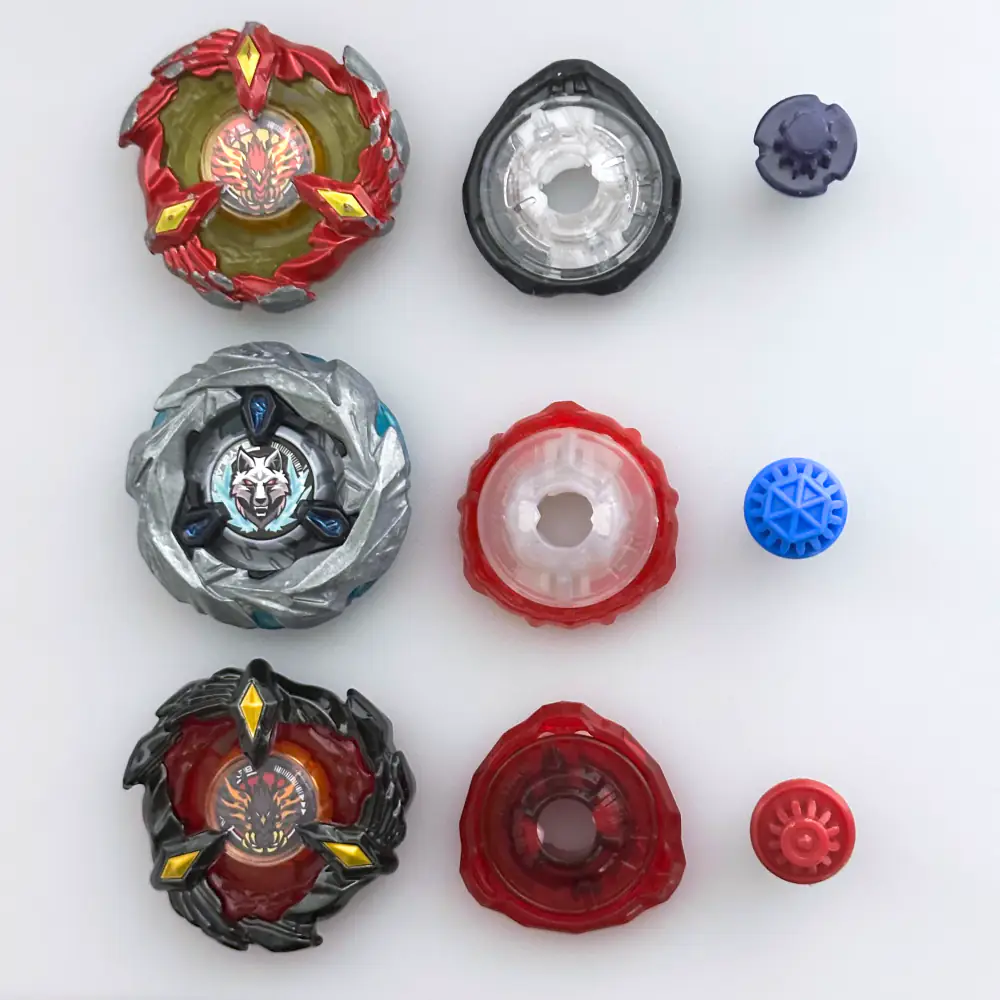
- PhoenixWing (Mold 1) 1-60LR
- SilverWolf 9-70H
- PhoenixWing (Mold 3) 3-60P
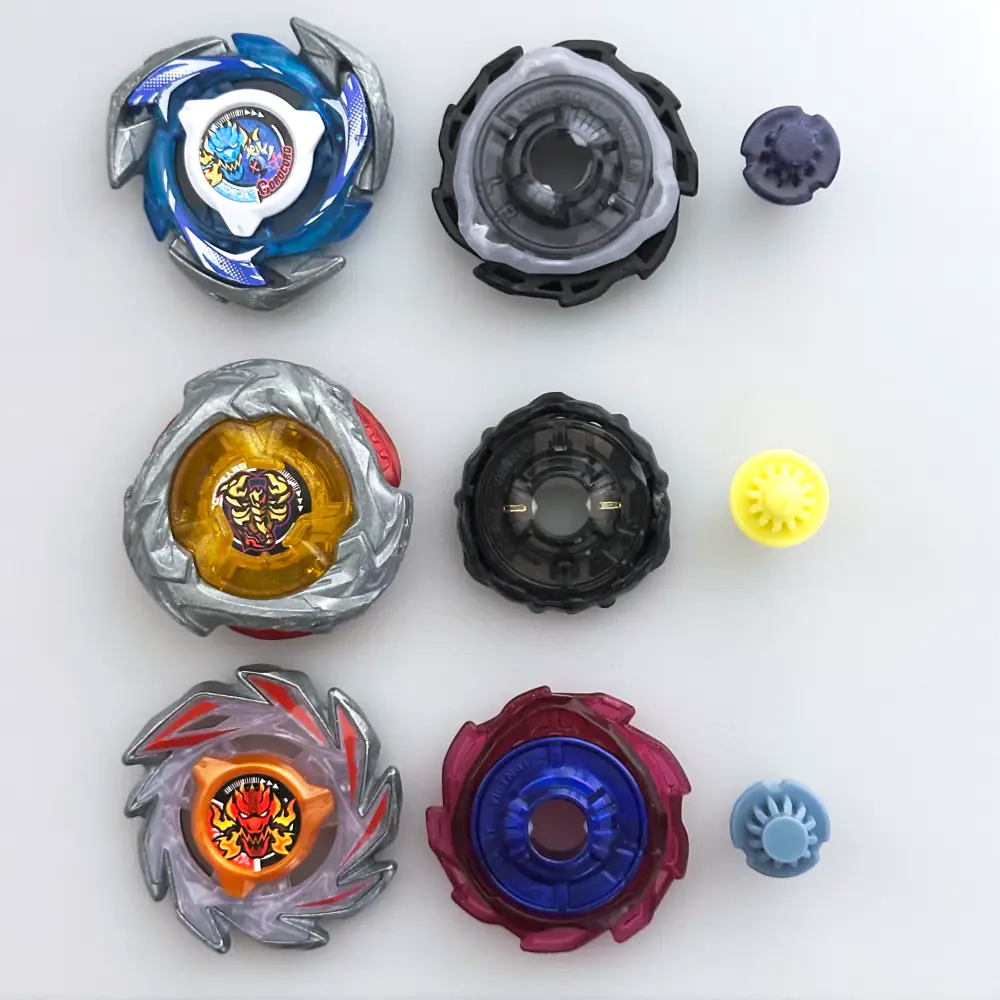
- DranBrave J3-60LR
- ScorpioSpear 9-60FB
- DranBrush J1-60LF
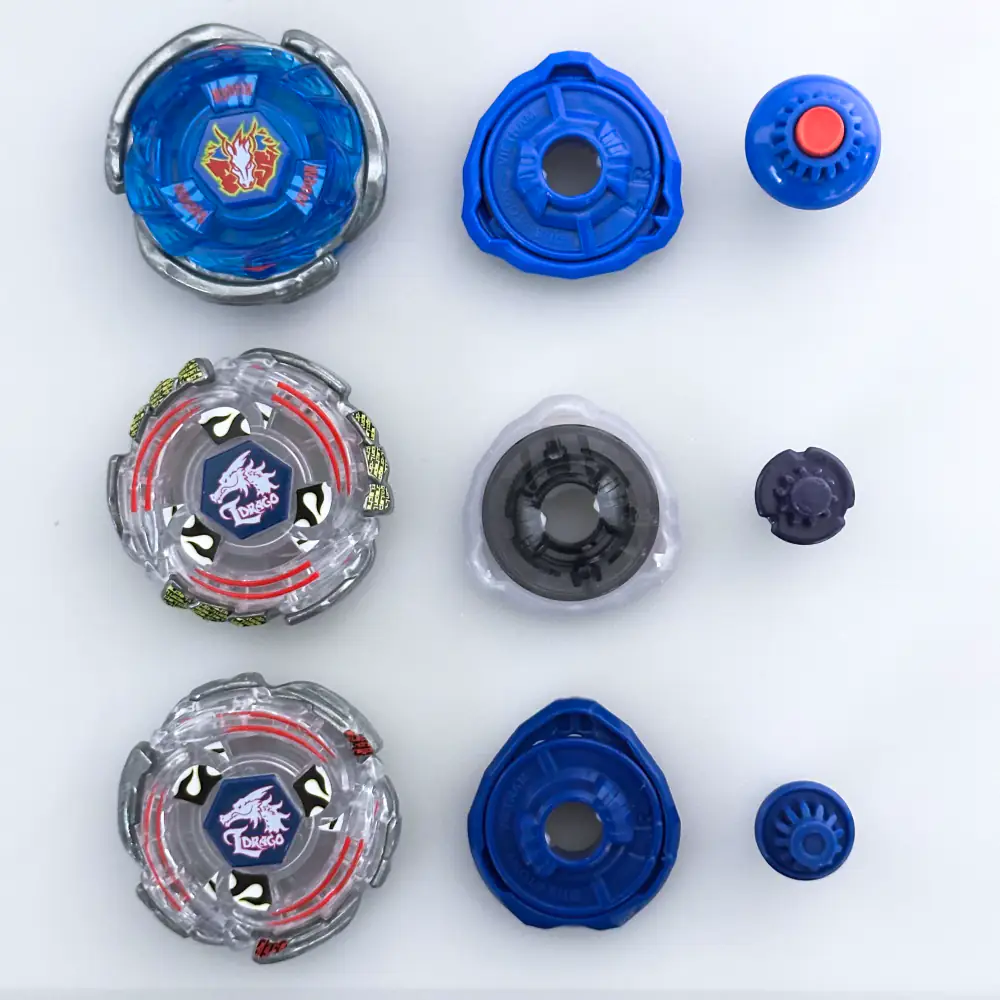
- StormPegasis 3-70RA
- Lightning L-Drago 3-60LR (Rapid-Hit Type)
- Lightning L-Drago 1-60F (Upper Type)
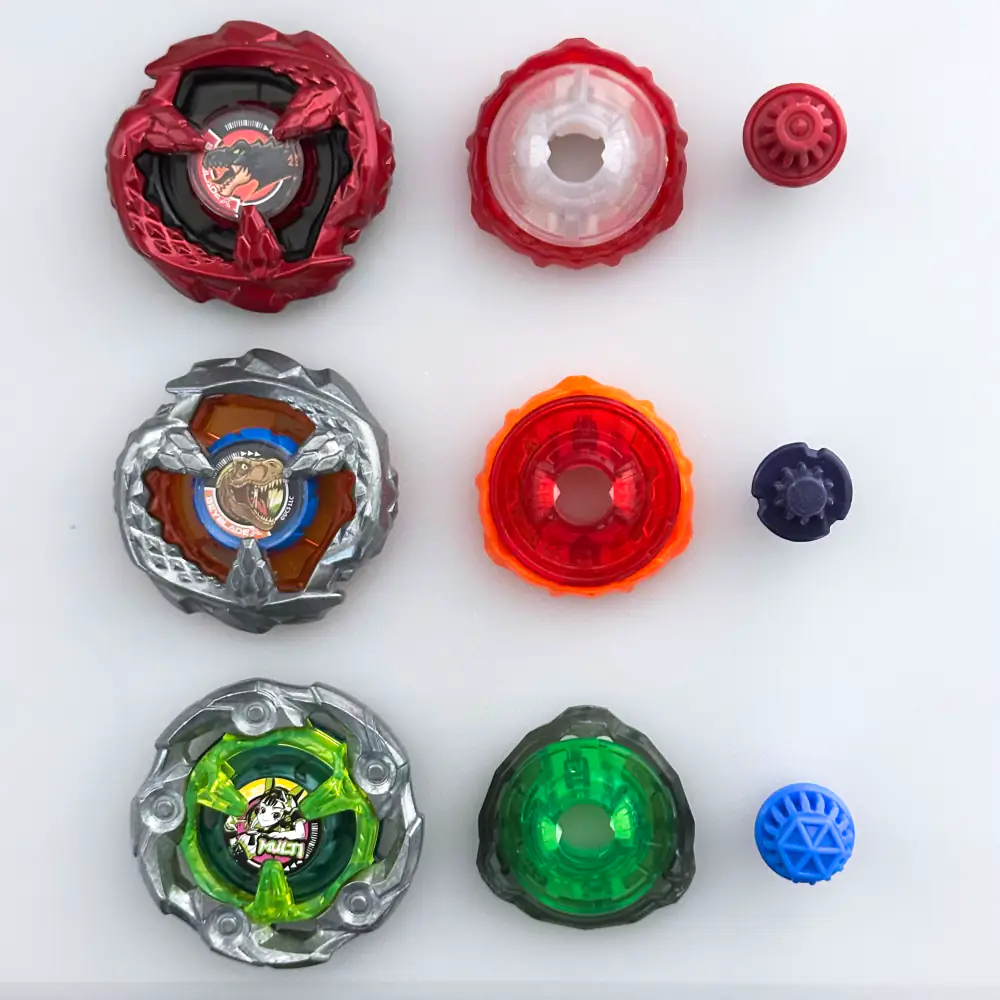
- TyrannoBeat 9-70P
- TyrannoBeat 9-80LR
- WizardRod 3-60H
Launcher
- The launcher is used to launch the Bey into the stadium for battle.
- Launchers have two types:
- String launchers, which are powered by an internal string mechanism.
- Winder launchers, which are powered by an external winder.
- Any official Beyblade X winder may be used with any winder launcher.
- Launchers may only be used with Beys of the matching spin direction (e.g. left launchers may only be used with Beys designated as left spin).
Stadium
Fig. 1. Stadium Components
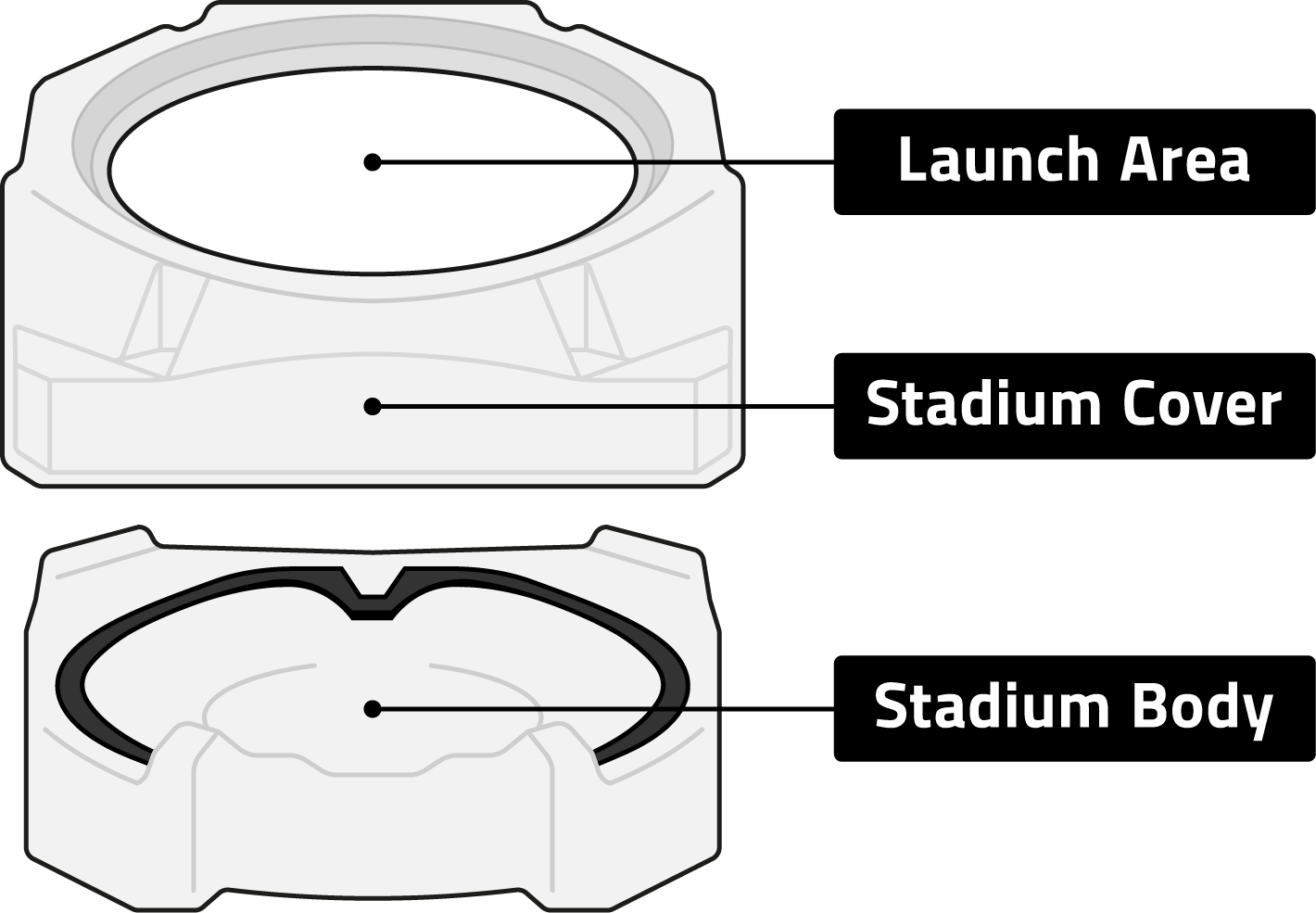
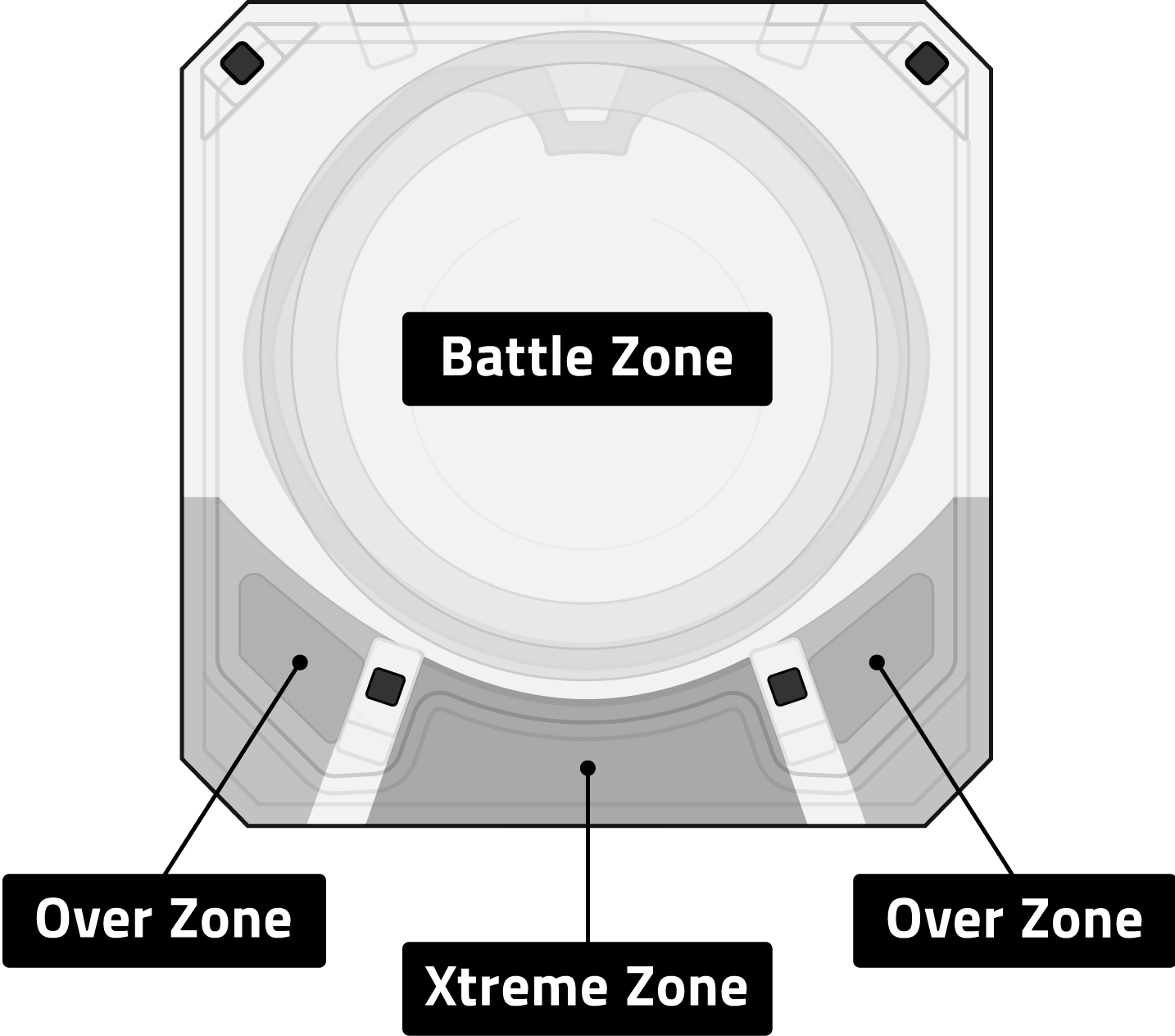
Fig. 2. Stadium Zones
- Battles take place in the stadium. This ruleset is only intended for Takara Tomy's “Xtreme Stadium” (aka Hasbro's “Tournament Beystadium”), with supplementary rulings for Takara Tomy's “Infinity Stadium”.
- The stadium is comprised of a stadium cover and stadium body (figure 1).
- The stadium cover includes the launch area, a circular opening through which Beys are launched.
- The stadium body is the surface Beys are launched onto.
- The space inside the stadium (between the stadium cover and stadium body) is divided into three types of zones (figure 2):
- the battle zone, consisting of the entire space inside the stadium except for the over zone and Xtreme zone
- the two over zones, located at the left and right corners, at the front of the stadium
- the Xtreme zone, located in the center, at the front of the stadium
- The stadium is placed on top of a flat, level play surface.
- Any barriers or objects other than the flat surface the stadium is placed on are not considered part of the play surface, even if they are attached to the play surface.
- Exercise caution when playing on elevated play surfaces, such as tables or stadium stands.
Battle Types
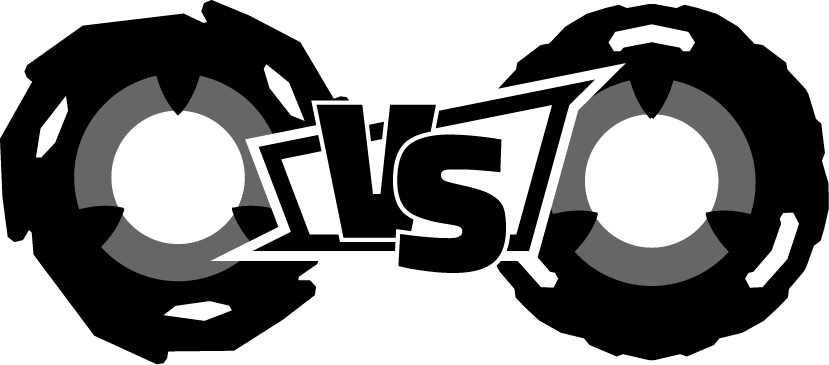
- Each blader selects one Bey and uses it for the entire match.
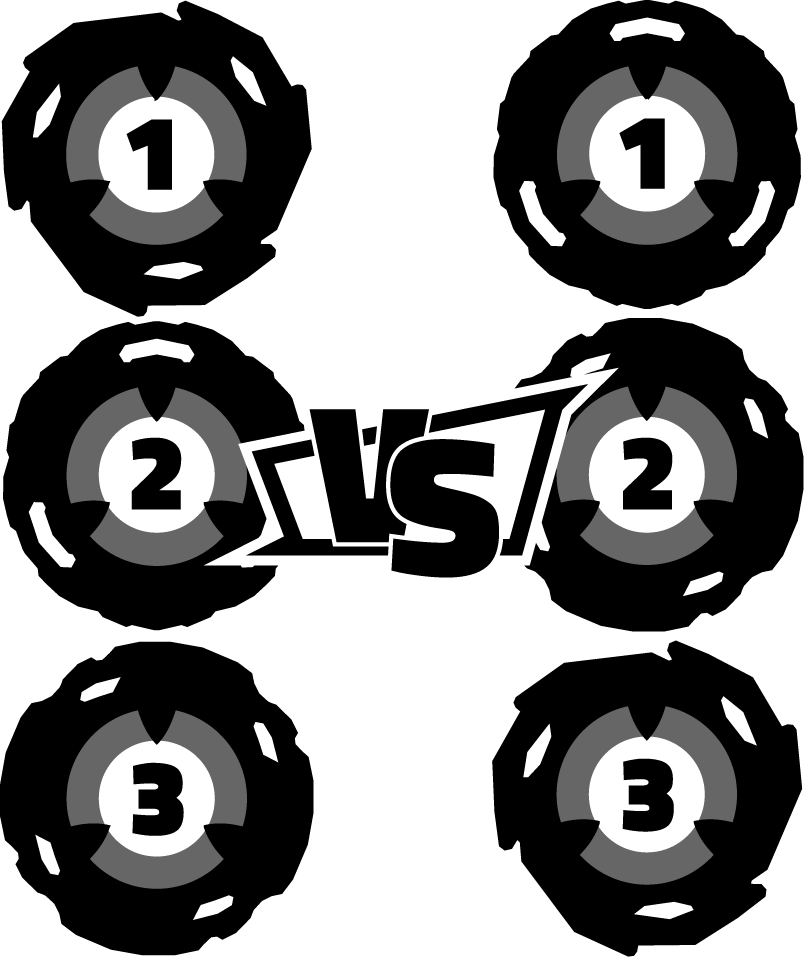
- Each blader selects a deck of 3 Beys, and orders their Beys from left to right as the 1st Bey, 2nd Bey, and 3rd Bey. The use of a deck case that conceals each Bey and separates their order is strongly recommended.
- For the first battle, each blader uses their 1st Bey. For each battle afterwards, bladers must use the next Bey in their deck order.
- After battling with the 3rd Bey, both bladers may change the order of their deck in secret. Then, each blader uses their 1st Bey for the next battle.
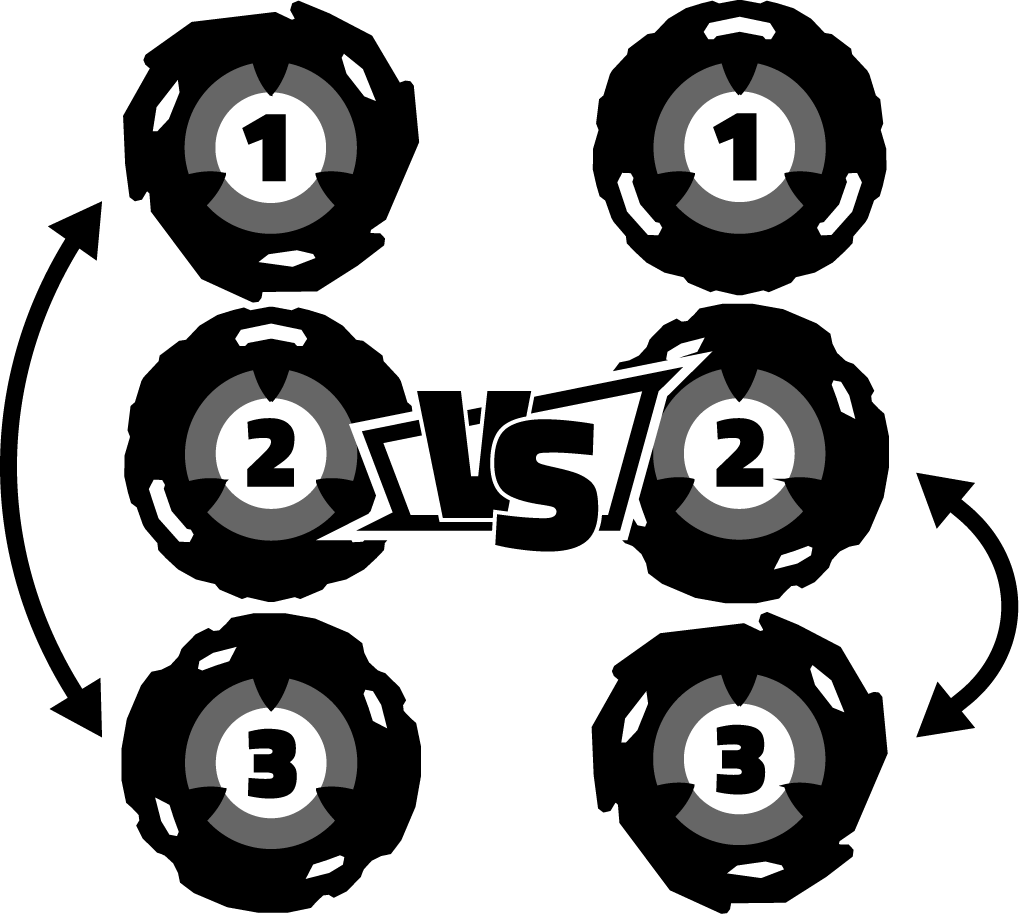
- Each blader selects a deck of up to 3 Beys.
- Before the first battle, each blader fully reveals their deck to the opponent. Then, each blader selects which Bey they will use for the first battle in secret.
- After presenting Beys for the first battle, both bladers’ decks must be visible at all times.
- The loser of each battle declares whether the next battle is a rematch or counter:
- If a rematch is declared, both bladers must use the same Beys and launchers without adjustment for the next battle. A rematch doesn’t affect the outcome of the previous battle.
- If a counter is declared, the winner of the previous battle selects any Bey in their deck to use for the next battle and presents it to the opponent. Then, the loser of the previous battle selects any Bey in their deck to use for the next battle and presents it.
Match Types
Earn 4 points to win the match.
Earn 5 points to win the match.
Earn 7 points to win the match.
Earn 4 points to win a set. Win two 4-point sets to win the match.
After each set, if the match continues, the loser of the previous set selects their launch position for the next set. Then both bladers can reorder their decks.
Winning the Match
- A Beyblade match consists of battles, points and sets.
- Battles: When two Beys are played against each other and a winning Bey is determined once, resulting in points being awarded.
- Points: Awarded to the winner of the battle. The number of points awarded is based on how the battle was won (see: battle result).
- Sets: Won when a blader has earned the required number of points. A blader cannot earn more points than the number required.
- You win the match when:
- 4-point, 5-point, and 7-point: you win one set with the required number of points.
- Best of 3 [4-point]: you win two 4-point sets.
Match Setup
Arrive at your stadium promptly with all required equipment.
One blader is randomly determined to select their launch position.
Bladers have one minute to finalize their Beys and deck order.
The judge checks each Bey to ensure they comply with the rules.
Match Start
- The match starts once both participating bladers and the judge have arrived at the stadium.
- Bring any equipment you may consider using during the match.
- Once the match starts, you may not receive assistance from others or leave the stadium without the judge’s permission.
Select Position
If the Infinity Stadium is being used, this step is optional and may be skipped.
- One blader is randomly determined to choose their launch position at either the left side or right side of the stadium.
- The blader who will choose their launch position is determined through a fair, randomized method decided by the judge (e.g. a coin flip, die roll, or rock-paper-scissors). The randomly determined blader then declares their position.
- The blader who didn’t choose a position must take the remaining position.
- Launch position must be chosen independently by the randomly determined blader. Bladers may not discuss launch positions at any point.
Select Beys
- Bladers select their Bey(s) for the match, including the initial order of their deck.
- Bey selection must be completed in secret (typically with both bladers turning their backs to the stadium).
- You may never attempt to gain information about the opponent’s Bey selection.
- Bey selection should be completed within 1 minute. Beyond 1 minute, the judge may ask you to immediately finalize your selection.
- Once your Bey selection is complete, inform the judge.
Judge Check
- The judge will take each blader’s Beys and check them to ensure they comply with equipment regulations and deck building rules.
- If the judge determines that a blader’s Beys cannot be used in the match, that blader does Bey selection once more.
- If a blader’s Beys are rejected by a judge check twice during the same match, they immediately lose the match.
- If you have questions about if you can use a part, ask before submitting to judge check.
- If a blader fails a judge check due to intentional cheating, they will be disqualified.
- The judge may disassemble Beys when checking them, and may return them disassembled. Ensure your Beys are fully assembled before playing the first battle.
- Alternatively, the judge may choose to retain each blader’s Beys and present them for each battle before returning them.
- The judge may request to check each blader’s launchers. If so, you must present all launchers you will use for the match alongside your Beys.
- Once the judge has confirmed that both bladers’ equipment can be used, the first battle will be played. After this point, the selected Beys and initial order of the deck cannot be changed.
Battle
Each blader clearly shows the Bey they will use to the opponent.
Beys are attached to launchers and held within legal launch range.
Beys are launched on the count of "three, two, one, go shoot! / let it rip!"
Battle until one or both Beys can no longer spin in the battle zone.
The battle winner is determined and earns points based on how they won.
Restart Battle: If an illegal launch, equipment failure or invalid battle result occurs, restart the battle at the Ready for Launch step
Present Beys
- Both bladers present the Bey they will use in the battle to each other by showing the top and bottom of the Bey so that all parts are clearly visible.
- You may ask your opponent to present their Bey again, or to verbally state the parts in their Bey.
- After both bladers have presented their Beys, both bladers may choose to adjust their Bey.
- When adjusting a Bey, a blader may adjust the orientation of parts in their Bey (such as rotating the position of the ratchet and/or bit), or change the mode of parts with mode change functionality, even if these adjustments require disassembly of the Bey.
- A blader must communicate to the opponent and the judge when they are about to adjust their Bey.
- If both bladers wish to adjust their Beys, both bladers must complete their adjustments in secret.
- Once the adjustment is complete and the Bey is fully assembled, the Bey is presented to the opponent again.
- Beys can only be adjusted once per battle.
Ready for Launch
If you require any assistance, accommodations, or adjustments to these rules in order to play safely and comfortably, please inform the tournament organizer and/or head judge (in advance when possible).
WBO believes strongly in making Beyblade accessible to all. Tournament organizers and judges are empowered to provide reasonable accommodations while preserving the fairness and integrity of play.
Launch Position
Fig. 3. Launch Positions
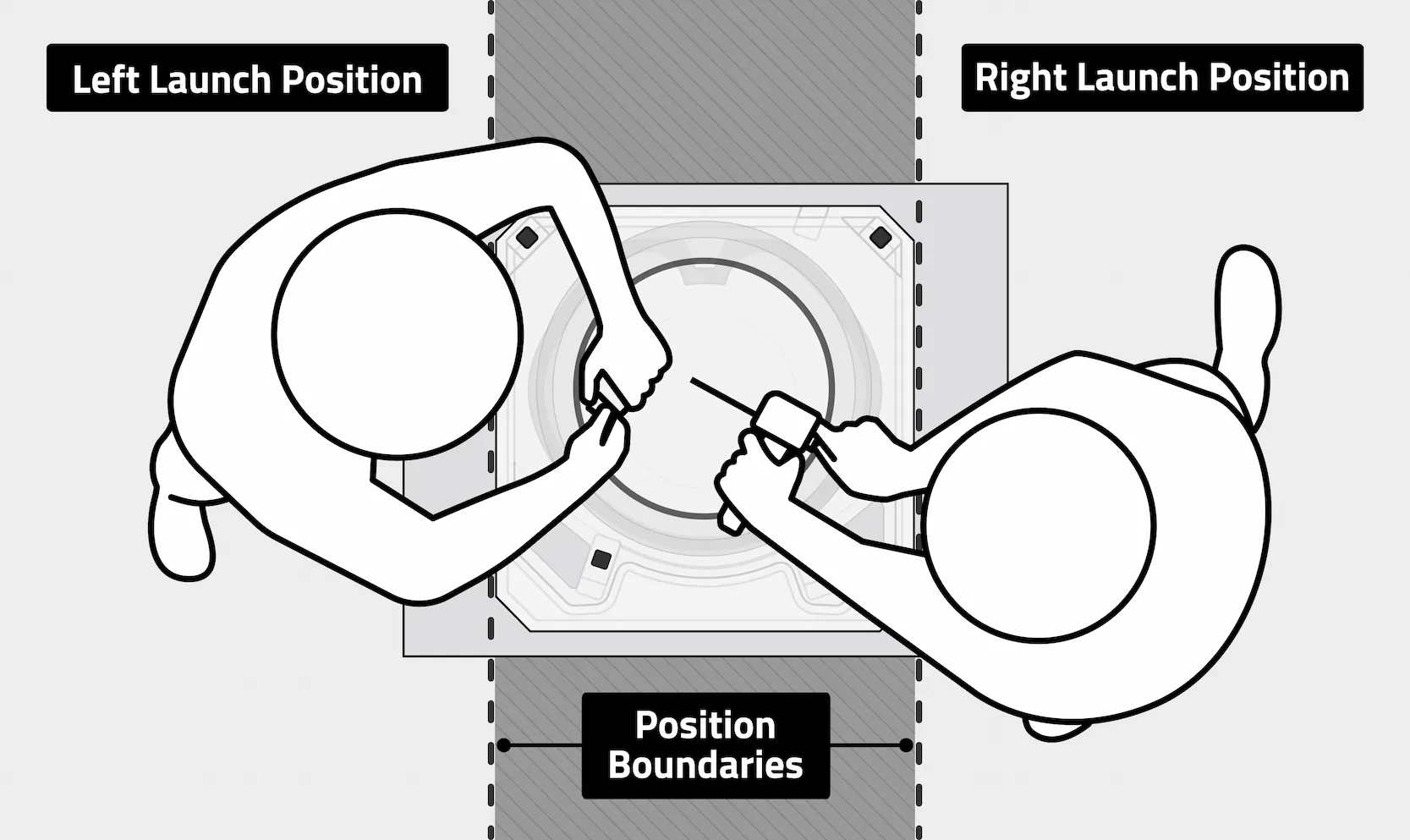
- Launch positions are the spaces each blader must launch their Bey from, determined during the select position step.
- The position boundary is an infinite line aligned to each blader’s stadium side, measured from the stadium itself (figure 3).
- You can position your lower body anywhere within your launch position as long as you:
- do not cross the position boundary
- do not interfere with the opponent’s launch
- do not interfere with the judge’s ability to judge the match
- do not risk impact with surrounding objects or people
- If the judge determines your positioning interferes with their ability to judge, the opponent’s ability to launch, or is unsafe, you must adjust it at their request.
Launch Range
Fig. 4. Launch Range
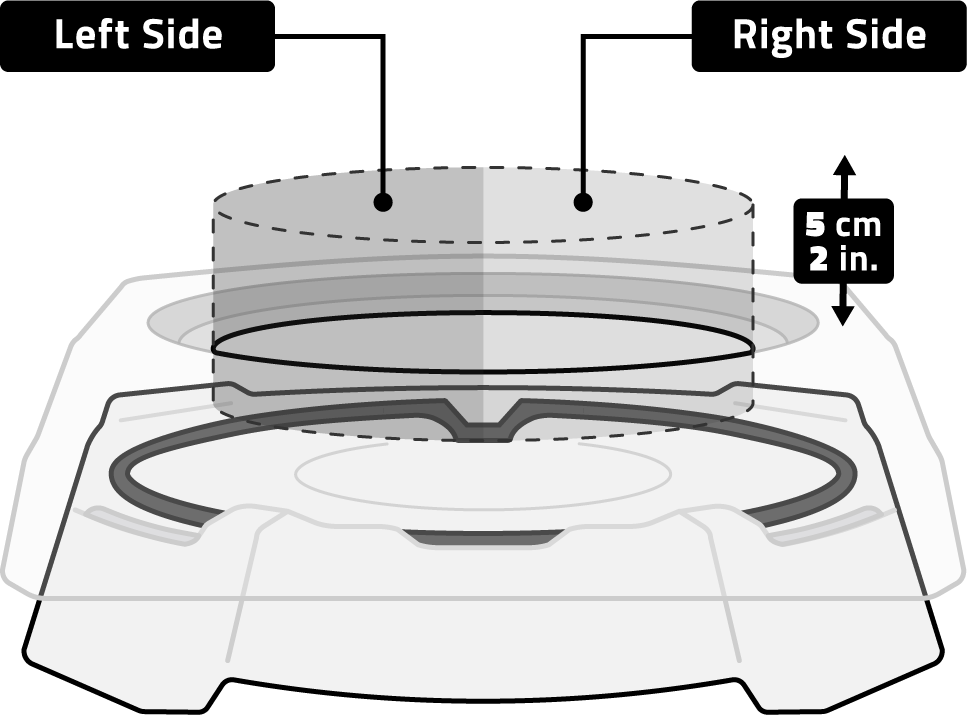
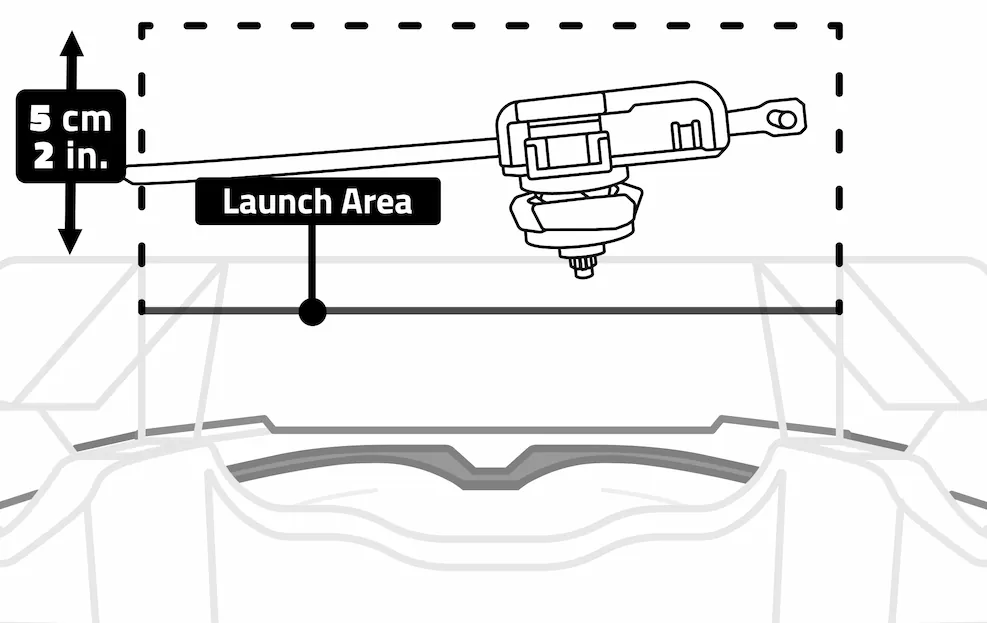
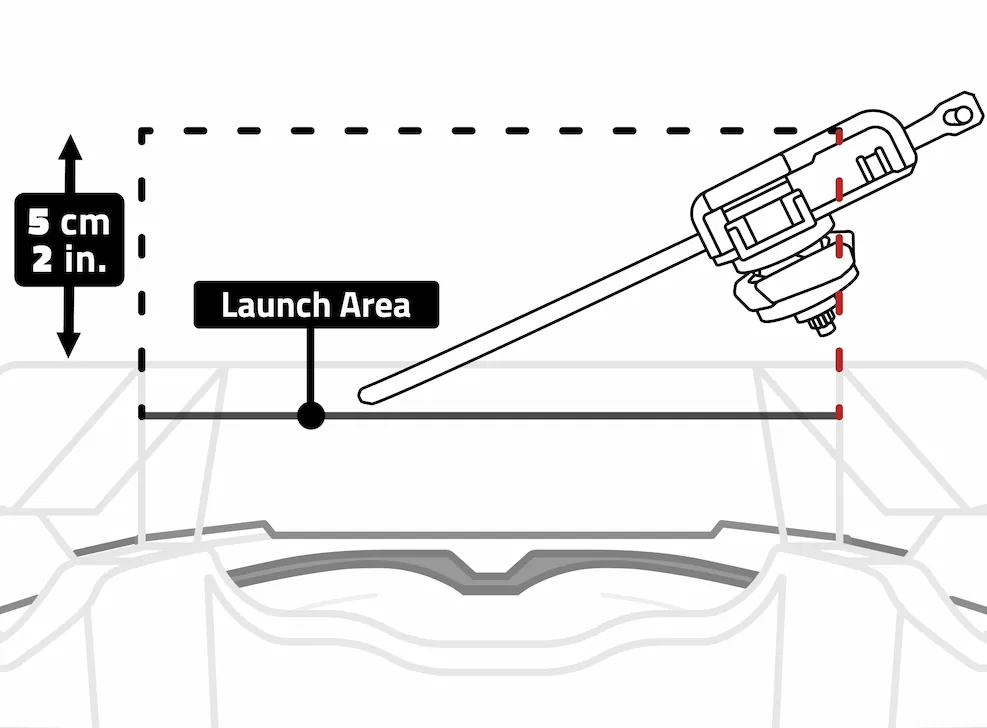
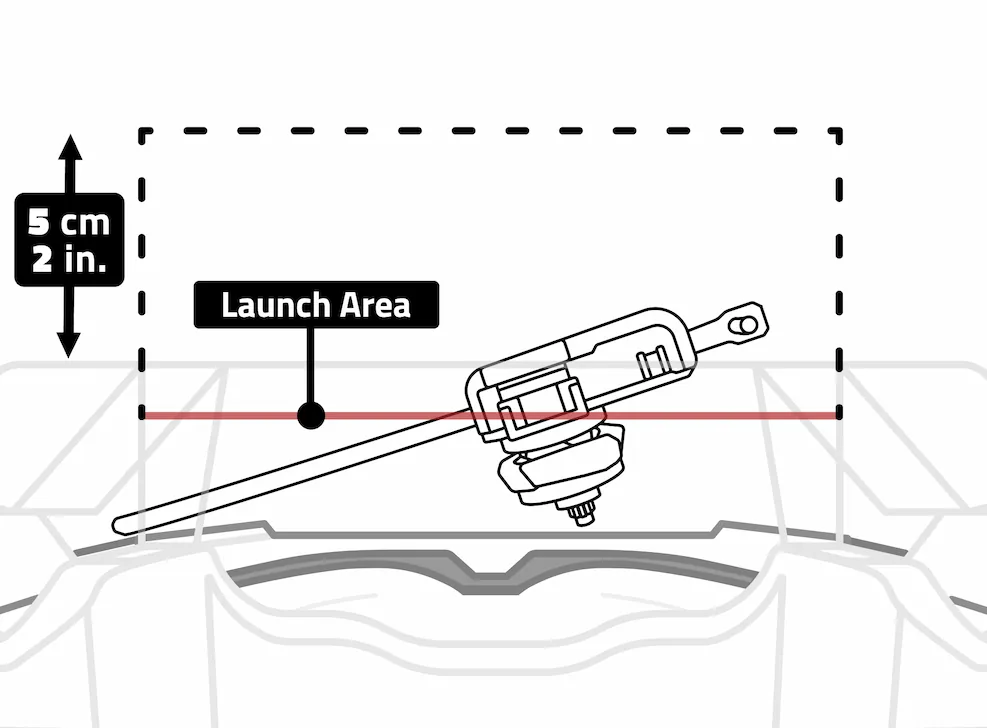
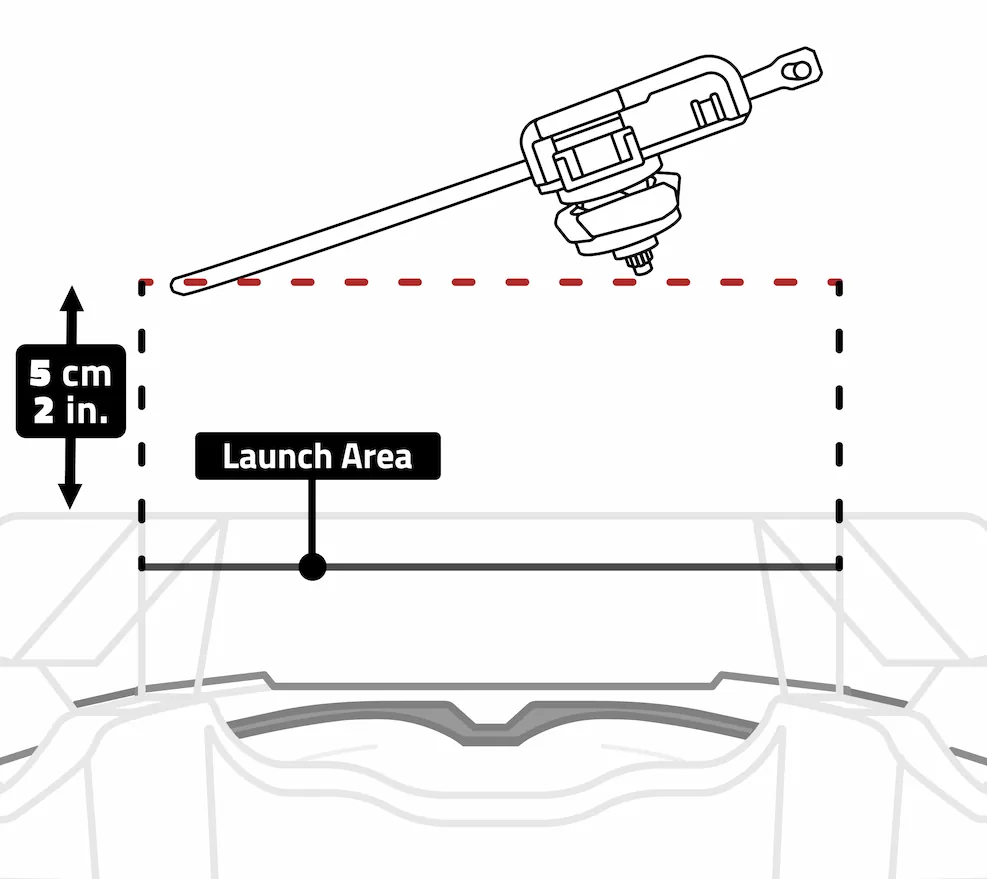
- Attach your Bey to your launcher and hold it within launch range (figure 4):
- directly above or within the launch area
- with at least part of your Bey above the opening of the launch area
- with at least part of your Bey within 5 cm/2 inches above the stadium cover’s highest point
- with the Bey not tilted more than 70° in any direction
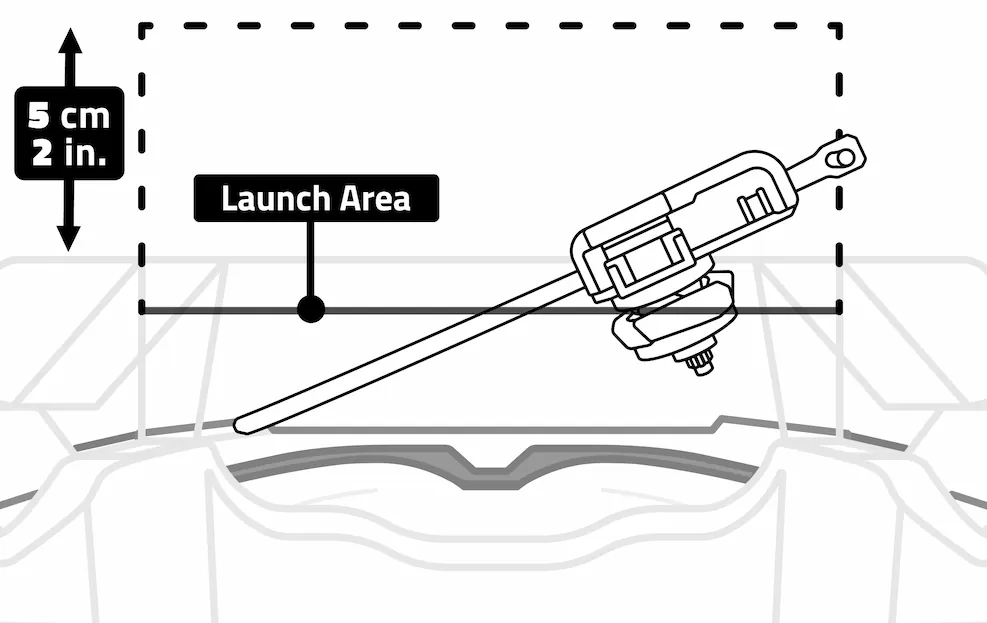
Within range. While part of the Bey is underneath the launch area opening, at least part of the Bey is above it.
Within range. The Bey is above the opening of the launch area, but below 5cm from the top of the stadium cover.
Out of range due to part of the Bey not being directly above or within the launch area.
Out of range due to the entire Bey being below the opening of the launch area.
Out of range due to the entire Bey being more than 5cm / 2" higher than the top of the stadium cover.
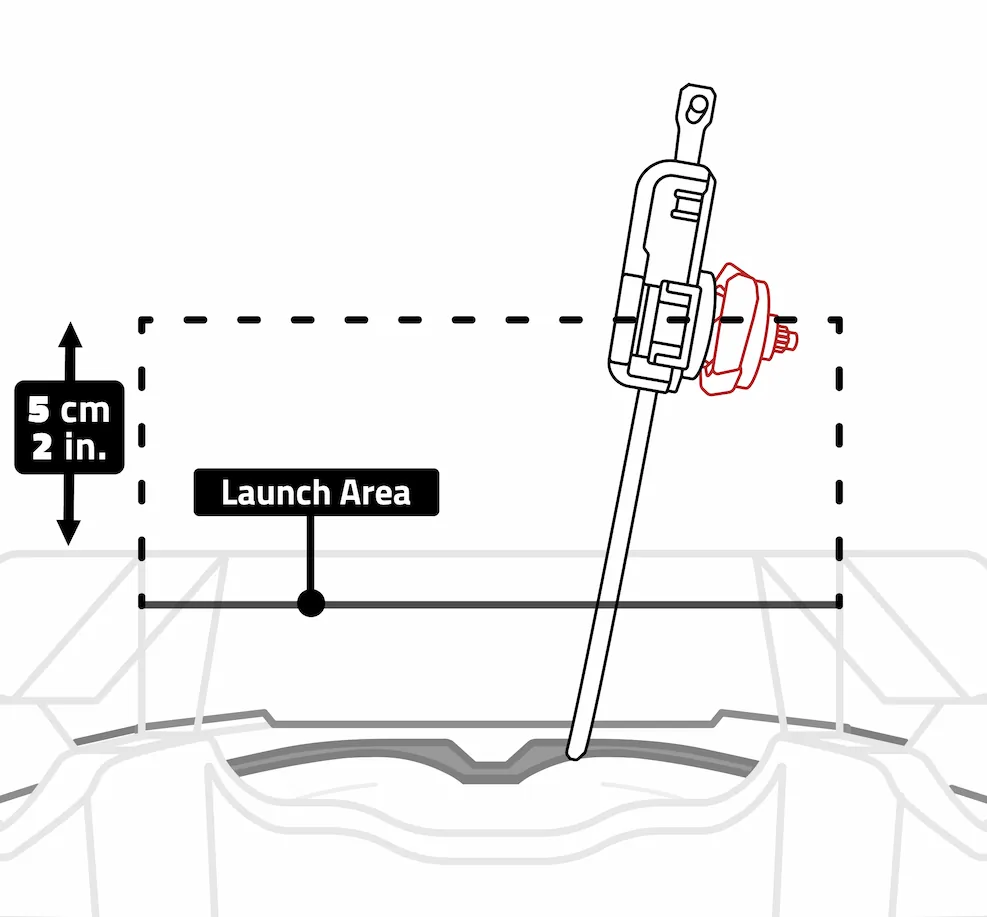
Out of range due to the Bey being tilted at an angle greater than 70°.
- The launch range is divided in half between the left side and right side of the stadium (figure 4).
- You may hold your Bey anywhere within range on your side, unless there is mutual interference.
- You may hold your Bey within range on the opponent's side only if it does not interfere with the opponent’s launch, as determined by the judge.
- You may move your Bey before and during launching as long as you remain within launch range and do not interfere with the opponent’s launch.
- Bladers may never touch their opponent with any part of their body or equipment, or otherwise interfere with their opponent’s launch.
- If you believe your opponent’s equipment interferes with your launch, inform your opponent and the judge.
- If the judge determines that a blader is interfering with their opponent’s launch, or there is mutual interference, the judge may require one or both bladers to make any specified adjustments.
- If a blader refuses to make specified adjustments, or intentionally interferes with their opponent’s launch, they will be disqualified.
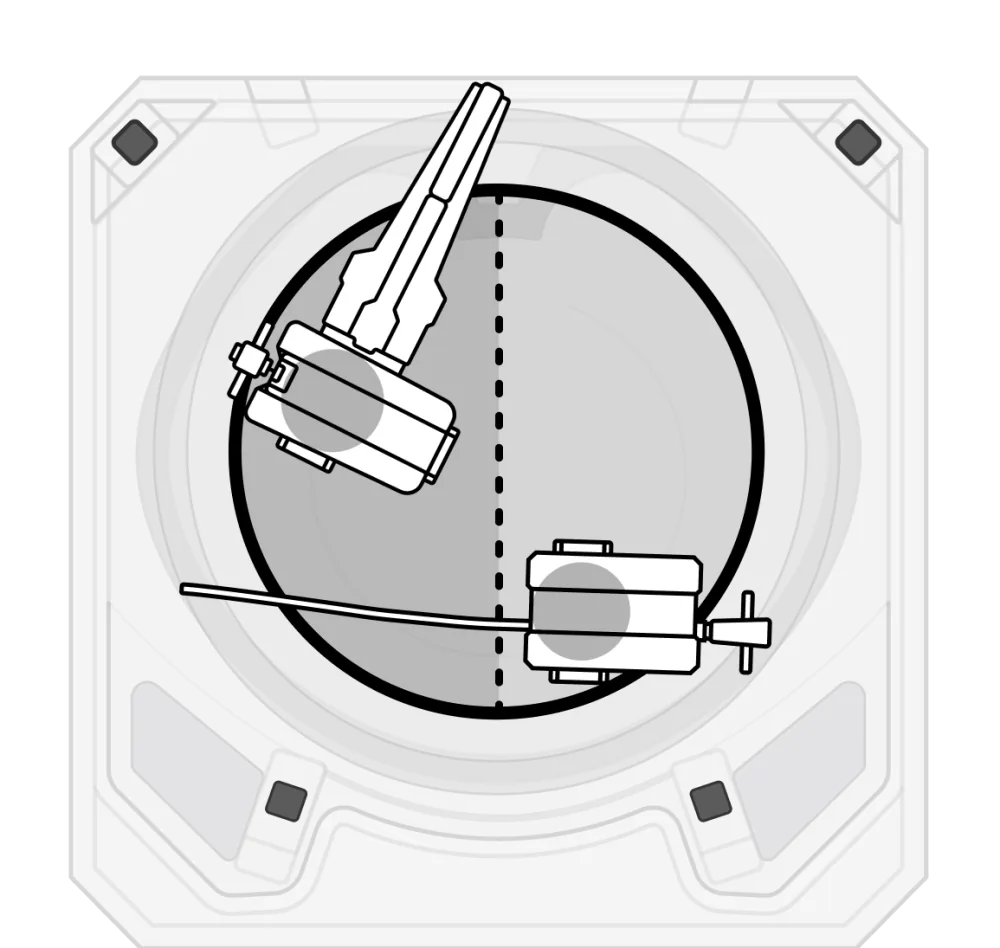
No interference. Both Beys are within their bladers' side of launch range, and neither blader's launch is physically obstructed.

No interference. While both Beys are within their opponents' side of launch range, neither bladers' launch is physically obstructed.

The left-side blader is interfering. Their Bey is fully within their opponent's side of the launch range, and their launcher physically obstructs the right-side blader's launch.
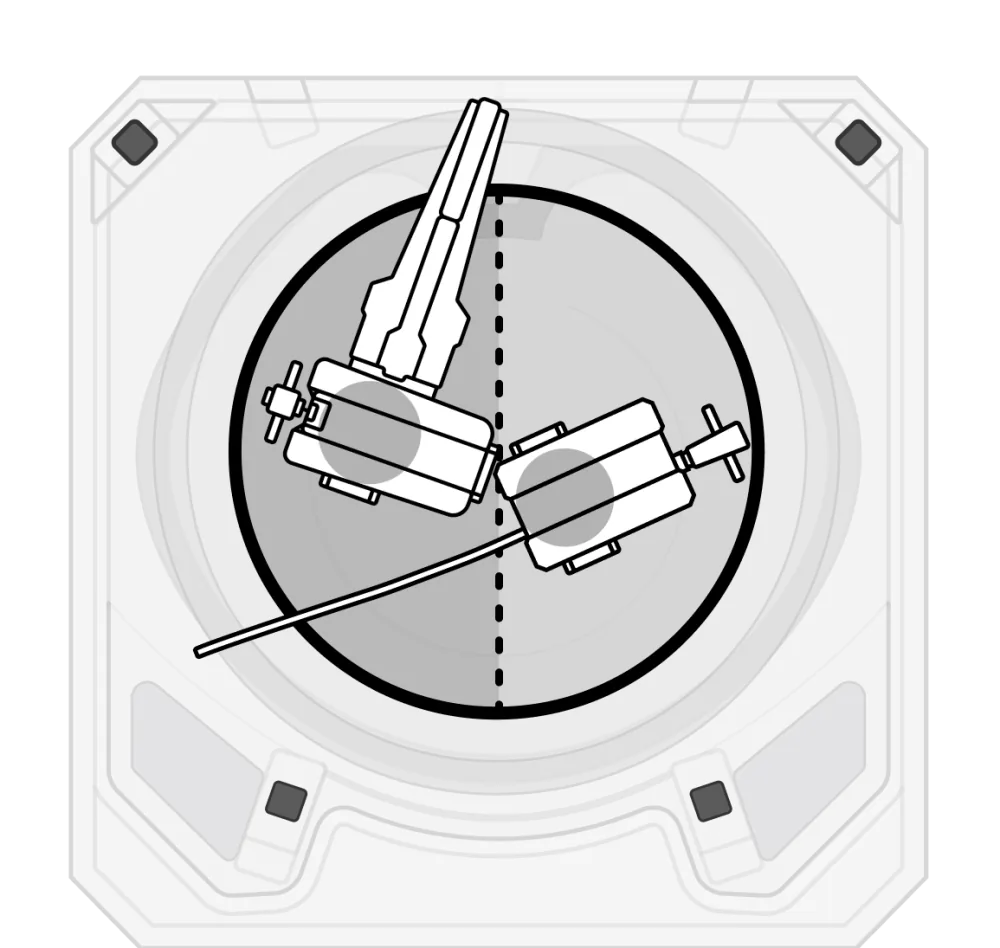
Both bladers are interfering with each other. While both bladers' Beys and launchers are fully within their own sides of launch range, they are physically obstructing each others' launches.
- Once both Beys are held within launch range and there is no interference, the judge will announce “ready set” to inform players that the countdown to launch is about to start. If you are not ready to launch, immediately tell the judge.
Launch
- During the countdown, the judge will call out: “three, two, one, go shoot!” or “three, two, one, let it rip!”
- Launch your Bey as the word “shoot” or “rip” is called. Do not begin pulling your winder/string before the word “shoot” or “rip” begins.
- Launch your Bey so that it passes through the launch area and touches the stadium before it touches the opponent's Bey.
- The judge will watch each blader’s launch to check for launch errors, launch interference, failed launches, and mid-air collisions. If any of these occur, the battle will be restarted.
- If during the countdown, a Bey moves outside of launch range, falls off the launcher or otherwise becomes unready to launch, the countdown will be paused and restarted.
- If the judge determines your launch method results in restarted battles, you must modify it at their request. If you do not, you will be disqualified.
- If your launch was obstructed due to your opponent’s interference, your launcher failing, or another event outside your control, you may request a restart.
Launch errors
- A blader commits a launch error when they:
- position their Bey outside of launch range while launching (out-of-range launch)
- launch or begin pulling their launcher’s winder/string before the word “shoot” or “rip” is called (early launch)
- launch after the word “shoot” or “rip” is called (late launch)
- launch their Bey outside the stadium (stadium miss)
- launch their Bey so that it touches the stadium cover before passing through the launch area (launch area miss)
- launch their Bey so that the blade hits the stadium body before any other part (flipped launch)
- touch the stadium with their body, launcher (except for the string of a string launcher), accessory or Bey while launching (stadium contact)
- When a blader commits a launch error, they receive a pending penalty, and the battle is restarted.
- When a blader commits a launch error while they have a pending penalty, the opposing blader receives 1 point (a penalty point). The pending penalty is then removed, and the battle is restarted.
- If both bladers commit a launch error during the same launch, neither blader will receive a pending penalty nor a penalty point.
- When either blader wins a battle, any pending penalties are removed for both bladers.
- If a blader commits a launch error, and a failed launch or launch interference also occurred during that launch, the launch error will be disregarded, and the battle will be restarted due to the failed launch or launch interference instead.
Failed launches
- A failed launch occurs when:
- A Bey bursts before it touches the stadium
- A Bey is not spinning when it first touches the stadium
- A Bey fails to release from its launcher
- When a failed launch occurs, the battle is restarted.
- The judge may choose to check the equipment used before restarting the battle, and may require bladers to change their equipment if they determine it is defective.
Launch interference
- Launch interference occurs when the judge determines that either blader’s launch has been interfered with, including but not limited to:
- one blader touches another with their body, launcher, or Bey
- a blader suddenly repositions in a way that interferes with their opponent’s launch
- When launch interference occurs, the battle is restarted.
- If the judge determines that the interference was due to one blader, and that the interference was intentional, severe, or repeated, they will be disqualified.
Mid-air collision
- Mid-air collision occurs when the Beys touch each other before both Beys have touched the stadium once.
- When mid-air collision occurs, the battle is restarted.
Requesting a restart
- You may request a restart only if:
- the opposing blader’s launch interfered with your launch
- you were hit or otherwise obstructed by a person or object while launching
- your launcher fails to function correctly or breaks during launching
- Request a restart by clearly saying “restart” and raising your hand immediately after launching.
- After requesting a restart, wait for the judge’s response, which may come after the battle ends. Then explain the reason for your request.
- If your request is approved due to a technical issue with your launcher, you must use a different launcher for the rest of the match.
- You may only request a restart for a launcher failure once per match.
- If you request a restart for a launcher failure, the judge may check your launcher, including performing a test launch with it.
- Requests for restarts are approved solely at the judge’s discretion.
Resolve Battle
- The battle starts once both Beys have passed through the launch area and touched the stadium, without any launch errors, failed launches, launch interference or mid-air collisions occurring.
- A Bey becomes finished when it stops spinning, bursts or is unable to return to the battle zone.
- The battle ends as soon as either:
- one Bey is spinning in the battle zone while the opposing Bey is finished, OR
- both Beys are finished.
- Do not touch any Beys or the stadium until the judge confirms the battle result. If you do, you will immediately lose the battle, and your opponent will receive 3 points. The battle will not be restarted.
Spinning and stops spinning
- A Bey is spinning for as long as it continues to rotate in its original spin direction at any speed and without any detached parts, regardless of the Bey’s axis, orientation or position.
- This includes:
- when the Bey is rolling against the stadium body
- when the Bey flips sideways or upside down
- when the Bey is outside the battle zone or stadium
- when the Bey cannot complete a full rotation, but is still rotating
- A Bey stops spinning the moment it ceases rotating in its original spin direction, or begins rotating in the opposite direction.
Burst
- A Bey bursts when any part of the Bey fully detaches and separates from the rest of the Bey.
- If a part partially detaches from a Bey but does not fully separate (e.g. a Bey’s bit pops out from the ratchet, but remains partially inside the ratchet), the Bey has not burst.
Unable to return to the battle zone
- A Bey is unable to return to the battle zone when:
- it stops spinning or bursts while outside the battle zone
- it completely exits the stadium directly from the Xtreme zone or over zone
- it touches anything other than the stadium, play surface, or the opposing Bey while outside the battle zone
- it exits the stadium through the launch area and then, while still outside the stadium, touches anything other than the stadium or the opposing Bey
- If a Bey exits the battle zone through the launch area:
- it is able to return to the battle zone as long as it does not stop spinning, burst, or touch any object other than the stadium or opposing Bey
- if it becomes unable to return to the battle zone, the battle is restarted
Resolving battle with BulletGriffon
- Beys including the parts Bullet/Rocket and Griffon are only considered finished when Griffon (the lower part) stops spinning, bursts, or becomes unable to return to the battle zone. Bullet (the upper part) cannot be finished.
- When Bullet detaches from Griffon, it is not considered a burst.
- If Bullet exits the stadium through an area other than Xtreme zone or over zone, and cannot return to the stadium, the battle is restarted.
Battle Result
- You score a finish when the opponent’s Bey is finished (unless the battle is restarted).
- When the battle ends, the blader that scored a finish wins the battle, and earns points based on how the opposing Bey was finished.
- Initiated when the opponent’s Bey enters the Xtreme zone.
- Scored when the opponent’s Bey becomes unable to return to the battle zone.
- Initiated when the opponent’s Bey enters the over zone.
- Scored when the opponent’s Bey becomes unable to return to the battle zone.
- Initiated and scored when the opponent’s Bey bursts while in the battle zone.
- Initiated and scored when the opponent’s Bey stops spinning while in the battle zone.
- A Bey enters a zone when the entire Bey is completely within that zone. It is considered to remain within that zone until the entire Bey leaves that zone.
- If both bladers score a finish, the first finish initiated wins. If the judge determines both finishes initiated at the same time, the battle is a draw, and is restarted.
- If a Bey enters the Xtreme or over zone, but returns to the battle zone still spinning, the initiated finish is reversed. When a finish is reversed, that finish is considered to have never been initiated and is not scored.
- In the “Infinity Stadium”, if a Bey enters the Xtreme or over zone, and then enters directly into a different Xtreme or over zone, the first Xtreme or over zone entered (and thus the first finish initiated) is scored when the Bey becomes unable to return to the battle zone.
After a battle winner has been determined and points have been awarded, unless the match has been won, continue to the next battle according to the match type and battle type.
Restart Battle
- A battle is restarted when:
- a launch error, failed launch, launch interference, or mid-air collision occurs
- a request for a restart due to launch obstruction is approved
- a Bey exits the stadium without passing through the Xtreme zone or over zone, and becomes unable to return to the battle zone
- a draw occurs
- a Bey’s part breaks
- the stadium breaks or part of the stadium detaches
- a Bey becomes stuck between the stadium cover and side of the stadium body while within the battle zone
- the judge otherwise determines that the fair and safe play of the battle has been interfered with
- When a battle is restarted, any result of that battle is canceled, and the battle is played again using the same Beys and launchers without adjustment.
- Begin the restarted battle at the launch position step, without presenting Beys.
- If a battle would be restarted at the same time a blader would win the set (such as after they receive a penalty point), instead of restarting the battle, that blader wins the set.
- If part of your Bey breaks during battle, or the judge otherwise determines that it no longer complies with equipment regulations, that part is removed from play. Then, either:
- Replace the removed part with another copy of the same part. The current battle is restarted.
- The removed part is not replaced, and the current battle is canceled. Both bladers return to the Select Beys step while retaining their current scores. You may not use any copy of the removed part for the rest of the match.
About Judges
- In a Beyblade tournament, every match must be overseen by a judge.
- The judge’s role is to ensure that all matches are played in accordance with the rules and that match results are accurately reported.
- If you have questions about the rules, you may ask the judge at any point other than when a battle is actively happening.
- If you have questions or concerns about a decision made by the judge, inform the judge immediately. Once the next battle begins, the previous battle’s result cannot be adjusted.
- At some tournaments, match footage may be recorded by judges to assist in making decisions, in line with WBO's recording rules and the organizer's recording policy.
- Some events may have a head judge and may allow you to appeal a ruling to them. You can ask the judge or the tournament organizer if this option is available.
- The final decision of the battle and/or match result belongs to the judge(s). You must accept the judge’s final decision. Disruptive behavior as a result of disagreeing with a judge’s decision will lead to disqualification.
Blader Conduct
- Be on time. Arrive by the tournament’s designated start time, and move promptly to your stadium when your match is called.
- Be ready to play. Review the event’s rules and arrive at your matches with legal equipment.
- Respect others. Avoid offensive and discriminatory language, “trash talking,” and other behavior that could disrupt the event or upset attendees and staff.
- Respect the venue. Keep the venue clean and avoid playing in ways that could damage the venue, stadiums or Beys.
- Put fairness first. Do your best to ensure the rules are always followed, both by yourself and your opponent. Do not intentionally circumvent the rules — if you’re not sure if something is legal, ask a judge.
- Follow the instructions of tournament staff. Tournament organizers and judges have the final say. If you disagree with a decision, calmly ask for a review. If you believe a judge or tournament organizer made the wrong decision, you can file a tournament issue report.
Recording Matches
- You may record your own matches with the judge’s permission, as long as it does not interfere with the match.
- Place your camera setup away from the judge and the opposing blader.
- Record one continuous video for the entire match. Do not start and stop recording during the match, as it may delay completion of the match.
- Footage recorded by bladers or spectators will not be considered by judges when making a decision.
- Judges may revoke a blader’s right to record matches at any time.
Disqualification
- At the discretion of the tournament organizer and judge(s), you may be disqualified from an event for any reason.
- If you are disqualified during a match, you will lose the match.
- The results of previous rounds will not be modified.
- If you are disqualified from an event, you forfeit any placement and prizing.
- If you are disqualified from an event, you may be suspended or banned from attending future events.
- If you believe you were unfairly disqualified, you can file a tournament issue report.
Equipment Regulations
- Only official Beyblade X parts and launchers produced by Takara Tomy and Hasbro may be used.
- Parts from previous generations of Beyblade may not be used.
- Some unofficial and custom launcher accessories are permitted (see: Launcher Regulations).
- Any modification of equipment beyond what is explicitly allowed in these regulations is forbidden.
- Any modification that may cause damage to a Bey or stadium (including cosmetic damage), or create an unfair advantage in battle, is forbidden even if that modification otherwise appears to be permitted by the regulations.
- Modified or unofficial parts, even if they appear to comply with these regulations, may be rejected at the judge’s discretion if they believe there is a possibility they will interfere with the fair and safe play of the match. Be prepared to switch to unmodified, official parts if necessary.
- Parts made up of individual components (such as ratchets) can be disassembled and reassembled.
- The reassembled part must identically match the construction and performance of a retail version of that part.
- All components (including screws) must be official, unmodified and undamaged.
- Parts that must be damaged to be disassembled (e.g. riveted parts) cannot be disassembled.
- Components from multiple different parts can be reassembled together.
Bey Regulations
- Parts cannot be painted except for small markings made with marker or thin paint. Clear coats cannot be used.
- Markings can applied to:
- Lock Chips: On the top center. Excludes metal lock chips.
- Blades: On top of the launcher hooks, and the top center of the gear chip.
- Ratchets: Anywhere on the underside of the ratchet base except for where the bit touches it.
- Bits: The top surface of the bit's shaft.
- Official stickers can be used in their official placements indicated in the product instructions.
- Custom or unofficial stickers can be used only on the gear chip or basic CX lock chips.
- Stickers must be thin and flat, and cannot contain offensive or inappropriate imagery.
- Custom stickers cannot be applied to metal lock chips.
- Stickers cannot be placed on top of other stickers, except for on top of stickers that were pre-applied to the product at retail.
- Parts that have been worn down outside of normal play cannot be used.
- Normal play is considered to be battling in an official stadium with a maximum of 2 other Beys.
- Parts that have been worn or damaged through contact with surfaces or objects other than a Bey or official stadium cannot be used.
- Parts which perform atypically due to a manufacturing defect (such as a bit manufactured with the incorrect level of burst resistance) cannot be used.
- Parts that are extremely worn cannot be used, even if worn through normal play.
- Extreme wear includes when a part’s shape or performance have dramatically changed from its original condition, e.g.
- a sharp bit becoming flattened, or a flat bit becoming round or sharpened.
- Extreme wear is determined at the judge’s discretion.
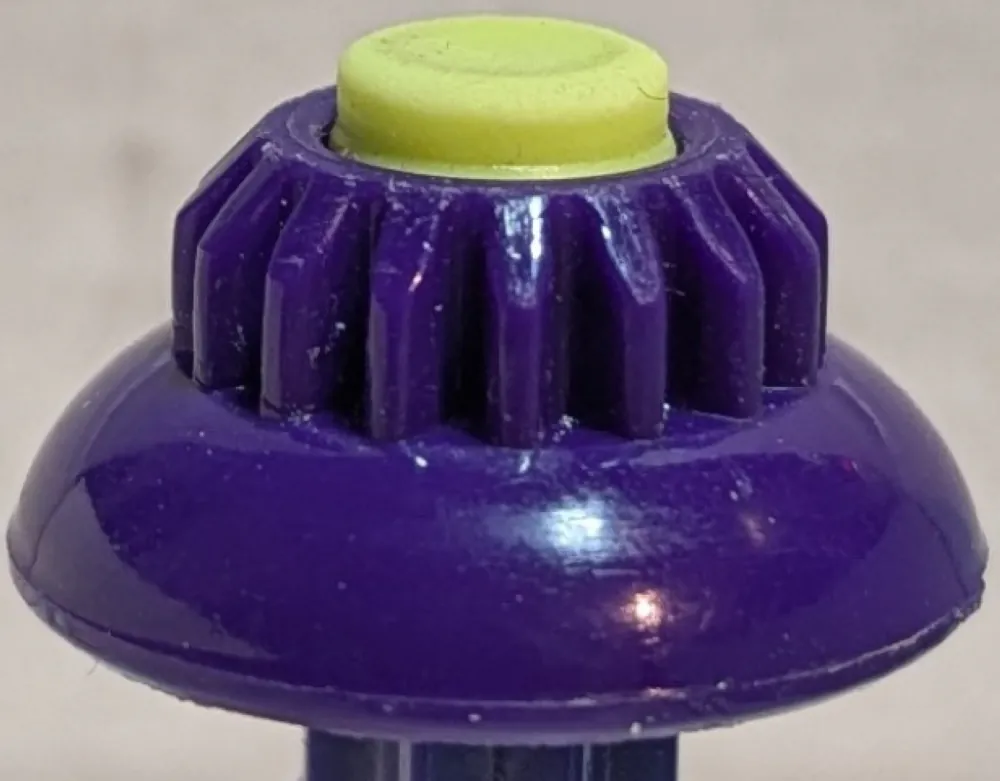
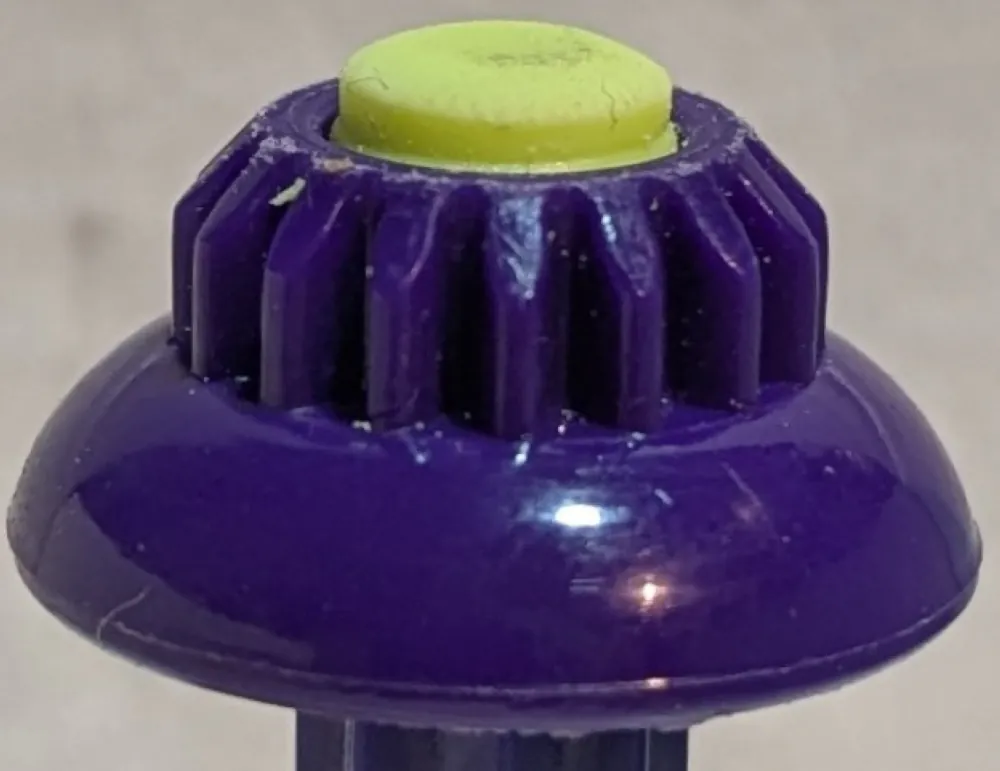
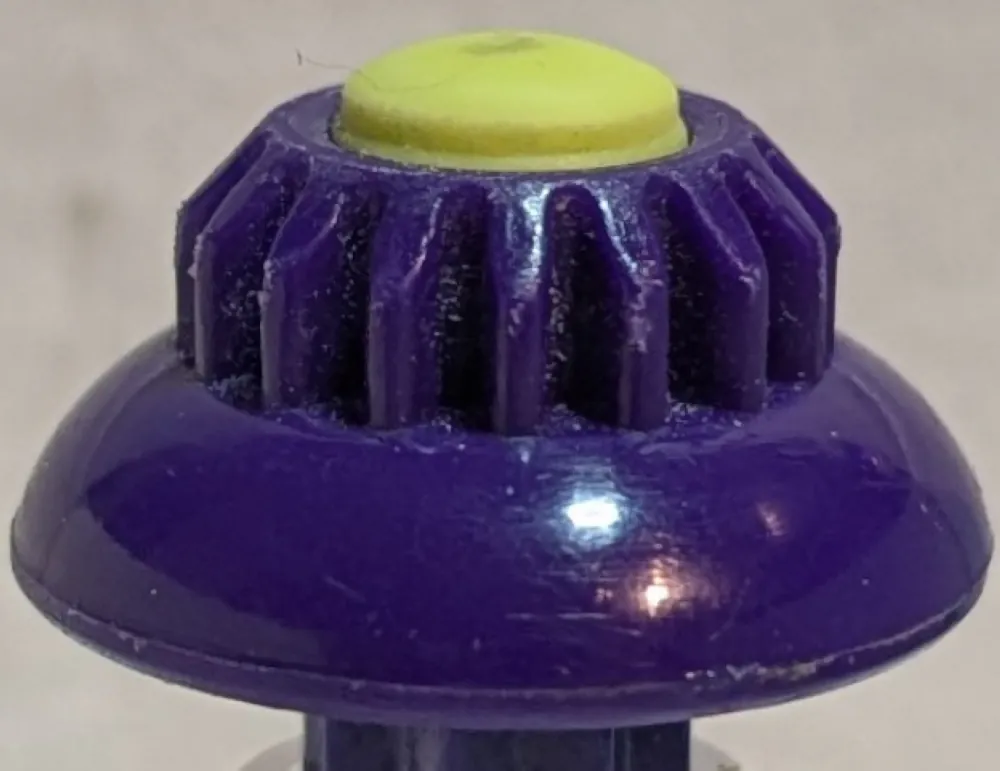
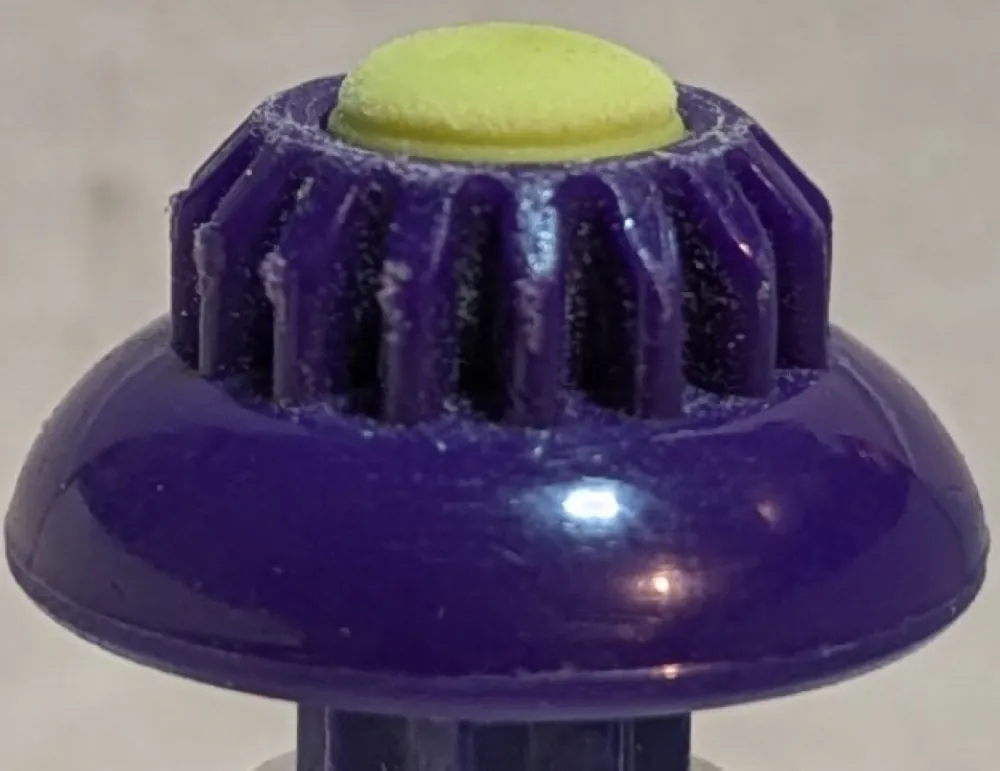
- Rubber bits (such as RA/Rubber Accel) wear down at an accelerated rate. Refer to the diagram below to determine whether a rubber bit is in legal condition.
Launcher Regulations
- Any type of winder may be used with any type of winder launcher.
- Winders: Winder, Long Winder, Entry Winder and Dragon Winder
- Winder launchers: Winder Launcher, Entry Launcher, Winder Launcher L, and Hold Launcher
- Winders cannot be modified in any way.
- Only one launcher grip can be attached to a launcher at a time.
- Launchers, launcher grips, and accessories may be decorated with paint and stickers.
- Applied paint or stickers may not affect performance.
- Designs must not contain any offensive or inappropriate imagery.
Unofficial Launcher Accessories
- Unofficial and custom-made launcher grips and accessories may be used primarily for aesthetic, ergonomic and accessibility reasons.
- Unofficial accessories must not:
- modify the function or performance of the launcher itself
- be electronically powered
- communicate information (such as launch angle or location)
- interfere with the opponent’s launch
- risk contact with the stadium (such as dangling accessories)
- be insecurely attached or otherwise unsafe, as determined by the judge
- provide a significant gameplay advantage, as determined by the judge
- Examples of acceptable accessories (non-inclusive):
- custom launcher grips with unique designs
- replications of official launcher grips from previous Beyblade generations (but not their accessories)
- custom attachments for the official Beyblade X Launcher Grip that alter its ergonomics
- handle attachments for winders and string launchers
Banned Parts
Bits
- MN/Metal Needle
- Reason: This bit frequently damages stadiums with its pointed metal tip.
Optional Rules
Optional rules can be used to modify the core ruleset above to create different gameplay experiences.
When an optional rule is in effect, it overrides any other rules that would contradict it.
Optional rules are the only modifications to this ruleset that are allowed in WBO Ranked League events.
- Registered deck list
- Bladers are required to register a deck list for one or both tournament stages.
- A registered deck list is a list of 3 Beys, including all of their parts by name.
- You must use only the Beys registered on your decklist for the designated tournament stage.
- You may not exchange parts between Beys in your registered decklist;
- you must use every combination as it was written when registered.
- Follow the tournament organizer’s instructions regarding how to register your decklist.
- If your part breaks or is otherwise removed from play by the judge, you must replace it with a copy of the same part. If you cannot, you lose the match.
- Registered side deck
- This rule can only be used alongside the registered deck list optional rule.
- When registering a deck, bladers can also register a side deck including up to 2 additional Beys.
- The Beys registered as a side deck cannot have repeating parts within the side deck.
- The side deck can contain parts that are also included in the main deck, as long as the deck used for each match contains no repeating parts.
- Own finish
- When you score an Xtreme finish or over finish against a Bey that did not touch your Bey during the battle, it is considered an own finish instead.
- When you score an own finish, you earn 1 point. Then, the battle is restarted.
- This optional rule can be applied to individual stages of the event.
- Out-of-bounds finish
- If the opposing Bey leaves the battle zone through the launch area and becomes unable to return, instead of restarting the battle, it will be considered an out-of-bounds finish.
- You initiate an out-of-bounds finish when the opposing Bey exits the battle zone through the launch area, and score when it becomes unable to return to the battle zone.
- An out-of-bounds finish is worth 1 or 2 points, as determined by the tournament organizer.
- Painted blades allowed
- Blades can be decorated with paint provided it does not affect performance, and is not applied to areas of the blade that touch other parts of the assembled Bey.
- Metal parts of blades can be dyed as long as they can be disassembled and reassembled without damage or any other modification. Plastic parts must not be dyed, as it may result in damage.
-
Paint may not be applied to metal lock chips such as Valkyrie and Emperor.
- Reveal and reorder
- After judge check is complete, each blader reveals their entire deck to their opponent.
- Then, each blader may reorder their deck before playing the first battle.
- Swap positions after battle
- After each battle within a set, the bladers swap launch positions.
- In a counter battle, this does not apply if the next battle is a rematch.
- Loser selects position after battle
- After each battle within a set, the loser of the previous battle chooses their launch position.
- In a counter battle, this does not apply if the next battle is a rematch.
- No disassembled components
- Parts that have been disassembled in a way not intended by the manufacturer (e.g. removing screws or separating ratchets) cannot be used.
- MN bit unbanned
- The MN (Metal Needle) bit may be used.
- Adjust before presenting
- Beys must be adjusted before being presented to the opponent, and cannot be adjusted after.
- No reverse (Infinity Stadium only)
- When a Bey leaves the battle zone and enters the Xtreme or over zone, the finish is initiated and scored the moment the majority of the Bey enters that Xtreme or over zone.
- The pocket walls dividing the Xtreme and over zones are considered part of the battle zone. If a Bey enters this space between zones, neither an Xtreme or over finish occurs.
- 3-second reverse countdown (Infinity Stadium only)
- When a Bey leaves the battle zone and enters the Xtreme or over zone, the judge begins a 3-second countdown.
- If the Bey does not return to the battle zone after the 3-second countdown, the initiated finish is scored.